Last updated: January 18, 2026
Most of us don’t need a stricter Monday routine, we need a calmer on-ramp. A good first week matters because it proves you can start. But what really changes your health is showing up again the next week, and the week after that, with the same simple basics.
Table of Contents
To help you jump to what you need, here’s what we’ll cover:
- Why your week starts before Monday
- Regulated > motivated (and why it matters)
- Choosing one daily anchor
- A simple Sunday-to-Monday plan
- When to loop in a clinician
- FAQ
Use this as a menu, then come back and re-read the section that feels most useful.
Why your week starts before Monday
The core idea is simple: your week starts before Monday. If you wait until the alarm goes off to “get it together,” you’re starting from pressure. If you clear friction earlier, follow-through feels less like willpower and more like momentum.
Think of this as a small, repeatable Sunday reset that makes Monday feel like a ramp instead of a cliff. The point isn’t perfection, it’s reducing the number of tiny obstacles that derail you when life gets busy.
Signal safety first: movement + breath
When your body feels tense or wired, it’s hard to “think” your way into focus. That’s why pairing light movement with a few minutes of breathwork can be such a powerful opener. Research reviews suggest breathing practices can support stress and anxiety reduction in part by shifting autonomic balance toward parasympathetic activity (your “rest-and-digest” side).
You don’t need a complicated method. A comfortable inhale and a slightly longer exhale is a simple place to start, and studies have linked prolonged exhalation with increased parasympathetic dominance as measured by heart rate variability.
One simple food choice that supports digestion early in the week
Pick one “easy win” that supports digestive health: add a fiber-rich item to your first meal on Monday (or your first meal after the weekend). Oats, beans, berries, chia, nuts, and extra vegetables all count.
Fiber can help digestion and help prevent constipation, but going from “low fiber” to “high fiber” overnight can backfire with gas or bloating, so increase gradually and pair it with fluids.
Reduce mental noise before you add productivity
Overwhelm usually isn’t a time-management problem, it’s a “too many open tabs” problem. Before you add goals, reduce mental noise:
- Do a 2-minute brain dump (everything looping in your mind)
- Circle the top 1–3 items that truly matter this week
- Pick one “not-to-do” boundary (one thing you’re allowed to postpone)
Close the loop on what’s noisy, and the rest of the week feels less like a grind and more like a sequence of small decisions.
Section takeaway: Start with the body (ease), support the gut (simplicity), and clear mental clutter (space).
Regulation > motivation (and why it matters)
Motivation spikes. Regulation carries you through.
In practical terms, you’re aiming for nervous system regulation: shifting from “threat mode” (rushed, reactive, scattered) toward a steadier baseline where follow-through is realistic. The goal isn’t to feel amazing every day, it’s to feel stable enough to repeat small habits.
Below are three “regulation levers” that tend to pay off quickly and compound over time.
Sleep: protect the most powerful mood lever
A supportive sleep routine doesn’t need to be perfect to matter. Consistency helps: going to bed and waking up around the same time, keeping the bedroom quiet and cool, turning off devices shortly before bed, and avoiding late caffeine, heavy meals, or alcohol close to bedtime can support better sleep.
If sleep has been rough, choose one change you can keep for a week, then keep it for another week. That’s how a “good first week” becomes a stable rhythm.
Hydration: reduce avoidable strain
Steady hydration habits are a low-effort way to reduce physical stress that can masquerade as mental fatigue. Dehydration can show up as thirst, dry mouth, darker urine, tiredness, dizziness, and less urination than usual.
You don’t need to obsess over numbers. A cue-based approach (water with meals, a visible bottle, checking urine color) can improve consistency without turning it into a chore.
Light: set your internal clock (and support your mood)
Your body uses light exposure to help set circadian timing, which influences alertness and sleepiness. Research on light and circadian rhythms shows that morning light tends to “advance” the body clock, while evening/night light tends to delay it.
In real life, that often means brief morning sunlight can be a meaningful signal, especially if you’re indoors most of the day. The key is timing and consistency more than intensity.
Section takeaway: Calm focus beats hype. A steadier baseline makes healthy choices easier to repeat.
Choosing one daily anchor
You don’t need a complicated routine, you need one default. That’s an anchor habit: a small action that “sets the tone” most days, even when everything else is messy.
An anchor habit works because it reduces decision fatigue. Instead of asking “What should I do today?”, you start with the same first domino. And when the first domino falls, your next choice usually gets easier.
Here are a few options many people find doable:
- Step outside for morning sunlight, then take a short, easy walk
- Keep a simple, repeatable first weekday meal (think “boring on purpose”)
- Do a 10-minute wind-down that supports your sleep routine (dim lights, screens away, light reading, warm shower)
Pick one and keep it intentionally simple. If your anchor is body-based, keep it gentle: light movement should feel like a downshift, not a workout.
Section takeaway: One steady default can make the entire week feel more stable.
A simple Sunday-to-Monday plan
If you like structure, here’s a repeatable plan that takes about 15 minutes. This is where the first week matters: it’s your “proof of start.” But the bigger win is doing the same plan again next week, because consistency is what turns a start into a habit.
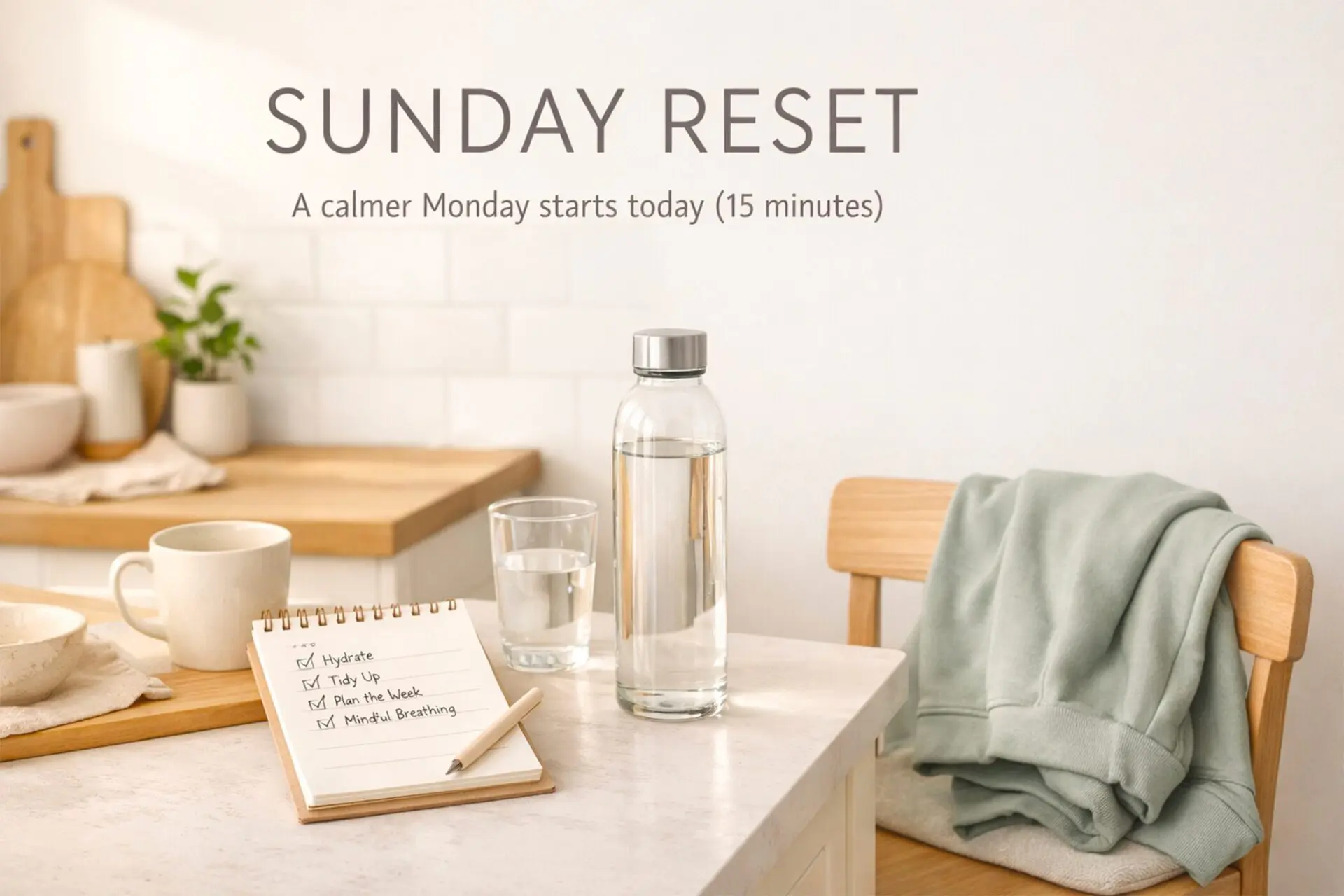
The 15-minute reset (copy/paste)
- 2 minutes: breathwork (slow inhale, slightly longer exhale, relaxed shoulders)
- 5 minutes: light movement (walk, stretch, gentle mobility, keep it easy)
- 3 minutes: prep one Monday-friendly choice for digestive health (wash fruit, portion oats, prep veggies)
- 2 minutes: set up hydration habits (fill a bottle, place a glass by the sink)
- 2 minutes: brain dump + circle your top 1–3 priorities
- 1 minute: add one friction reducer (lay out clothes, clear a counter, pack a bag)
Done consistently, this is the kind of system that makes “Monday discipline” feel less necessary, because you’re not starting from chaos.
Monday morning: keep the first 10 minutes gentle
For many people, the biggest Monday mistake is immediate input: news, inbox, scrolling. If you can, begin with your anchor habit, then do one easy task to build momentum.
If your default is stepping outside for morning sunlight, treat it like brushing your teeth: small, automatic, and not up for debate.
Section takeaway: The first week gets you started. Repeating the same small plan week after week is what changes your baseline.
FAQ
Q: What if a weekly reset feels impossible on Sundays?
A: Make it smaller and move it. A 5-minute reset on Monday night still counts. You’re building consistency, not a perfect calendar.
Q: How do I choose an anchor habit I’ll actually keep?
A: Choose the one that feels almost too easy. Tie your anchor habit to something you already do, and aim for “most days,” not perfection.
Q: What does nervous system regulation look like in real life?
A: It looks like fewer reactive choices: steadier mood, less urgency, and more ability to pause before responding—especially when the week gets busy.
Q: Does morning sunlight still help if it’s cloudy or I only have a few minutes?
A: Usually, yes. Outdoor light is often brighter than indoor light even on overcast days, and consistent morning sunlightcan still help with timing cues.
Q: Is light exposure only about sleep?
A: No. Daytime brightness can influence alertness and timing cues throughout the day, while evening light can delay circadian timing.
Q: What’s a realistic sleep routine if my schedule changes week to week?
A: Pick one “non-negotiable” you can keep: a consistent wake time, a short wind-down, or a device cutoff. One stable piece of a sleep routine can help the rest fluctuate less.
Q: How do hydration habits fit with coffee or tea?
A: Caffeinated drinks can contribute to fluids for many people, but they don’t always replace plain water well. If caffeine makes you jittery or disrupts sleep, shift timing and lean on simple hydration habits.
Q: What kind of breathwork is simplest if I get anxious?
A: Keep it basic: comfortable breathing with a longer exhale than inhale. If breathwork spikes anxiety, stop and try grounding (feet on floor, name 5 things you see) and consider professional support.
Q: Does light movement “count” if I’m sore or have joint pain?
A: It can. The goal is gentle circulation and a downshift, not intensity. If pain is sharp, new, or worsening, get medical guidance.
Works Cited
- Centers for Disease Control and Prevention (CDC). “About Sleep.”
- Harvard Health Publishing. “Sleep hygiene: Simple practices for better rest.”
- MedlinePlus. “Dietary Fiber.”
- MedlinePlus Medical Encyclopedia. “Fiber.”
- MedlinePlus. “Dehydration.”
- Mayo Clinic. “Dehydration — Symptoms & causes.”
- Blume C, et al. “Effects of light on human circadian rhythms, sleep and mood.”
- Bentley TGK, et al. “Breathing Practices for Stress and Anxiety Reduction.”