Last updated: January 22, 2026
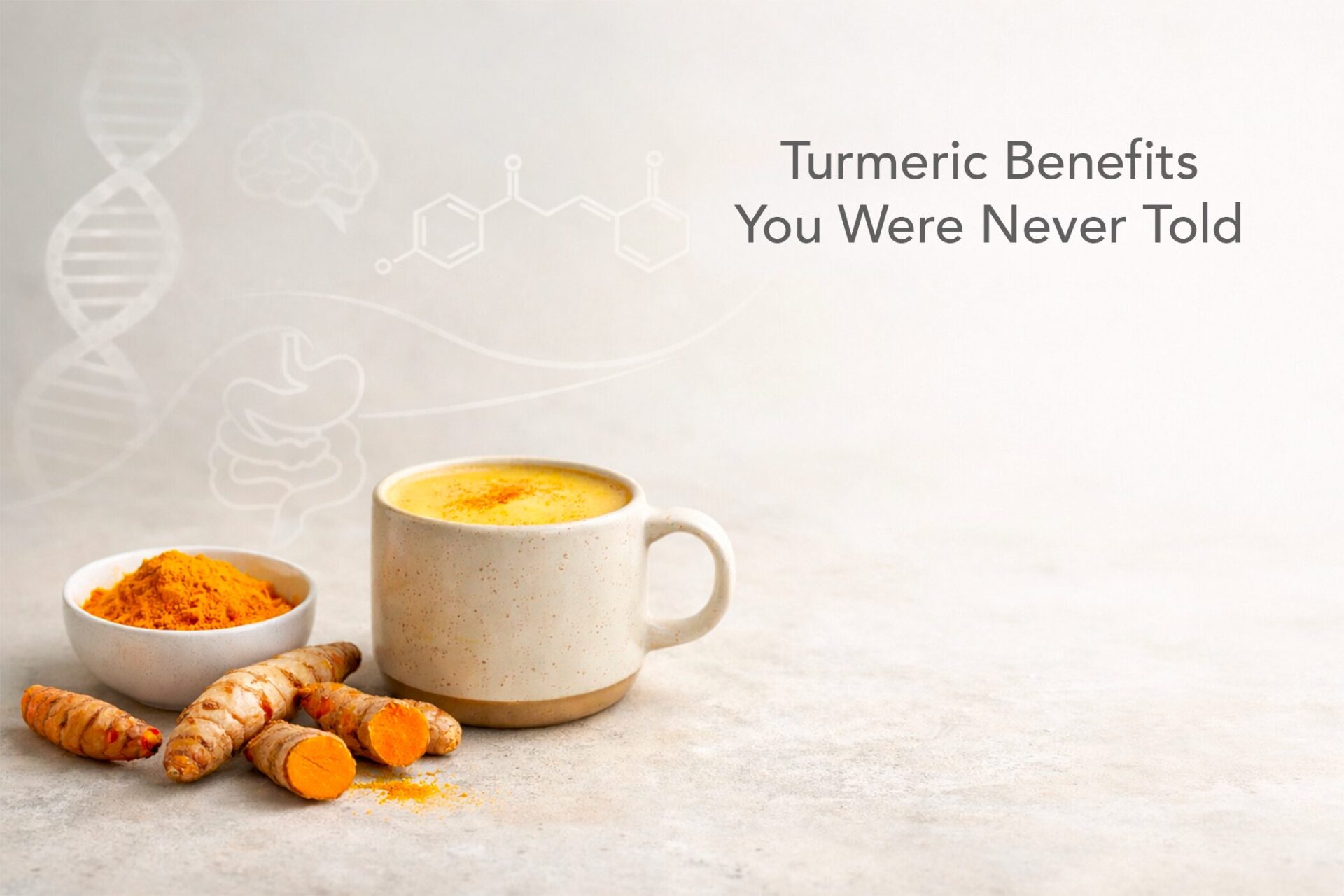
People talk about Turmeric benefits for achy joints, but curcumin (turmeric’s best-studied compound) may also touch gut barrier health, brain protection, and blood sugar balance, and the biggest practical limiter is curcumin absorption.
Table of Contents
- Why turmeric can feel different than “just another spice”
- Gene-level inflammation signaling: the NF-κB connection
- The gut lining: supporting the barrier (not just “digestion”)
- Brain, memory, and mood: what’s plausible and what’s still early
- Training and soreness: where curcumin fits in recovery
- Metabolic and liver pathways: glucose signaling and bile flow
- Making it work in real life: absorption and timing
- Safety notes and red flags
- FAQ
- Works Cited
Why turmeric can feel different than “just another spice”
Turmeric is a culinary plant, but its research story is mostly about curcumin’s ability to interact with multiple pathways at once, especially inflammatory signaling and oxidative stress. That “multi-target” behavior is one reason people report broad, subtle changes (less stiffness, steadier digestion, better resilience after hard workouts), even though results in studies vary based on the formulation and the person.
Takeaway: Turmeric isn’t magic, it’s biology plus context (dose form, consistency, and individual response).
Gene-level inflammation signaling: the NF-κB connection
Inflammation isn’t just a symptom; it’s a communication system. One key “switchboard” is NF-κB, a transcription factor that helps turn on genes involved in inflammatory responses. Research has long shown that curcumin can inhibit NF-κB activation in cell and animal models, which is part of why it’s studied so heavily for inflammatory conditions.
Another layer is epigenetics and gene expression, how cells “read” DNA without changing the DNA itself. Curcumin has been described in reviews as an epigenetic modulator (influencing processes like histone modification and DNA methylation in experimental settings), which may help explain why its effects can look upstream—more like dialing down signaling than merely masking discomfort.
To put it plainly, this is anti-inflammatory support that aims at signaling pathways rather than a quick numbing effect.
Takeaway: The most compelling science angle is that curcumin interacts with inflammation “switches” such as NF-κB, an upstream target that may influence multiple downstream symptoms.
The gut lining: supporting the barrier (not just “digestion”)
A calmer stomach is nice, but the more interesting idea is the intestinal barrier: the layer of cells and tight junction proteins that decides what stays in the gut and what passes into the body. When that barrier is stressed, immune activation can rise, one proposed route for systemic inflammation “starting in the gut.”
A detailed review on curcumin and intestinal barrier function describes how curcumin can modulate tight junction organization and reduce permeability signals in experimental models, including effects tied to inflammatory triggers. This is why people interested in “leaky gut” discussions often focus less on “bloating fixes” and more on gut barrier health as a longer-game foundation.
If you want to use turmeric as food, you can support the gut environment in practical ways. Here are a few food-forward options people tolerate well (and that don’t require chasing high doses):
- Add turmeric to soups, lentils, or chili near the end of cooking.
- Stir into yogurt or kefir with cinnamon and fruit.
- Use it in a vinaigrette with olive oil for roasted vegetables.
These options can be gentle entry points, especially for sensitive stomachs.
Takeaway: Beyond digestion talk, the emerging theme is barrier integrity, one reason gut barrier health keeps showing up in curcumin research conversations.
Brain, memory, and mood: what’s plausible and what’s still early
Curcumin is often framed as a “brain-friendly” compound because it’s lipophilic and has been studied in relation to blood-brain barrier biology, neuroinflammation, and oxidative stress. Some reviews discuss curcumin’s potential to permeate or influence the blood–brain barrier, yet also emphasize that getting meaningful levels to the brain is constrained by low oral bioavailability and delivery challenges.
BDNF and learning signals
BDNF (brain-derived neurotrophic factor) is a growth-support signal involved in learning, synaptic plasticity, and resilience. Reviews of curcumin’s neuroprotective mechanisms often include BDNF-related pathways as one plausible contributor, mostly drawing from preclinical and mechanistic data. That’s one reason curcumin gets discussed for brain protection, even though human outcomes depend heavily on formulation and study design.
Mood effects: inflammation-meets-neurochemistry
Depression and anxiety are not “just inflammation,” but inflammation can be one piece of the puzzle for some people. Recent meta-analyses of randomized trials have reported that curcumin supplementation is associated with improvements in depressive symptoms on average, with the usual caveat: trials differ in populations, formulations, and quality, and results vary by individual.
This is where the discussion of mood regulation often lands: curcumin may reduce certain inflammatory signals while also interacting with neurotransmitter-related pathways (indirectly), which could matter most when inflammation is a meaningful driver.
Takeaway: Curcumin’s reputation for brain protection and mood regulation is grounded in plausible mechanisms and growing human trial data, but delivery/bioavailability still shapes real-world results.
Training and soreness: where curcumin fits in recovery
If you’ve ever had delayed-onset muscle soreness (DOMS), you know it’s not just “pain”, it’s a mix of micro-damage, inflammation signaling, and oxidative stress. Reviews and meta-analyses suggest curcumin supplementation may improve some aspects of DOMS and recovery markers, though study protocols vary widely (timing, dosing, training status).
A useful nuance: some athletes worry that aggressive anti-inflammatory strategies could blunt training adaptations. While the research is more developed for NSAIDs than for curcumin, curcumin is generally discussed as modulating inflammatory signaling rather than shutting it down completely, one reason it’s often positioned as a gentler recovery tool.
If your goal is exercise recovery, the simplest rule is consistency around harder sessions rather than random “as-needed” use.
Takeaway: Evidence is strongest for curcumin as a soreness-and-recovery support, an option many people explore for exercise recovery when training volume climbs.
Curcumin is also studied for cardiometabolic markers. In a large systematic review of randomized trials, turmeric/curcumin supplementation was associated with improvements in measures such as fasting blood sugar, fasting insulin, HbA1c, and insulin resistance indices overall, again with variability by study design and participant characteristics.
That’s the practical angle behind blood sugar balance: not a replacement for diet, movement, sleep, or prescribed care, more like a potential supporting actor.
“Detox” language—what’s real here?
The liver doesn’t need trendy cleanses; it needs functioning pathways. Curcumin has been studied for its interactions with oxidative stress pathways and detoxification enzymes (often discussed as phase I/phase II systems, and Nrf2-related signaling in experimental models).
People summarize this as liver support, but the responsible framing is: curcumin may support normal bile and enzyme pathways in some contexts, while the supplement form (especially high-dose or enhanced-absorption products) also has safety considerations discussed below.
Takeaway: The most defensible “metabolic” promise is modest support for blood sugar balance, alongside mechanistic research that’s sometimes summarized as liver support.
Making it work in real life: absorption and timing
Here’s the “big miss” that trips people up: curcumin absorption is low when curcumin is taken by itself in a conventional form. That’s why some people feel nothing from turmeric capsules, while others swear by certain formulations.
Black pepper and fat: why golden lattes can make sense
A classic human study reported that piperine (from black pepper) dramatically increased curcumin bioavailability, often summarized as “up to ~2,000%,” depending on how it’s calculated from exposure measurements. Taking curcumin with dietary fat can also help because curcumin is fat-soluble.
If you’re choosing a curcumin supplement, look for transparent labeling and third-party testing, and remember that “enhanced absorption” can be a double-edged sword for people prone to side effects.
Timing: morning, post-workout, or night?
People tend to experiment with timing for comfort and consistency:
- Daytime use is often chosen for general inflammation signaling and mobility habits.
- After training is popular for DOMS routines and exercise recovery consistency.
- Evening use can feel calming for some people, but mildly stimulating for others—so it’s a personal trial.
This is also where some people notice mood regulation effects most clearly, either improved steadiness or, occasionally, restlessness if taken too late.
Takeaway: If turmeric “does nothing,” start by solving curcumin absorption and finding a schedule you’ll actually follow; that’s where results often live or die.
FAQ
1) What are the most realistic Turmeric benefits to expect?
For many people, the most realistic Turmeric benefits are subtle: less day-to-day stiffness, steadier digestion, or better tolerance of training load. Outcomes depend heavily on formulation, consistency, and your baseline inflammation drivers.
2) Does turmeric actually help with inflammation without “shutting down” immunity?
Curcumin is often described as immunomodulatory—meaning it may dial down inflammatory signaling (including pathways like NF-κB) rather than acting like a classic immunosuppressant drug. That’s why some people use it as anti-inflammatory support, but it still warrants caution if you’re immunocompromised or on immune-altering medications.
3) Can turmeric help “leaky gut”?
Human evidence is still emerging, but mechanistic and preclinical work supports curcumin’s role in tight junction proteins and barrier integrity. If your focus is gut barrier health, prioritize food-first habits (fiber, protein adequacy, alcohol moderation) and treat curcumin as an add-on—not a fix-all.
4) How do I improve curcumin absorption without overcomplicating it?
The simplest approach is pairing turmeric/curcumin with fat and (when appropriate for you) black pepper. Since curcumin absorption is naturally low, these strategies can meaningfully change exposure—though “more absorbed” can also mean “more side effects” in sensitive people.
5) Is there evidence for mood benefits?
Meta-analyses of randomized trials suggest curcumin can improve depressive symptoms on average, which is why it’s discussed for mood regulation—especially when inflammation is a relevant contributor. It’s not a substitute for therapy, sleep, movement, or prescribed treatment.
6) What about memory and aging—does it help the brain?
Curcumin is studied for neuroinflammation and oxidative stress pathways, and some reviews include BDNF-related mechanisms. The cautious takeaway: there’s plausible rationale for brain protection, but real-world effects depend on delivery and individual factors.
7) Should I take it around workouts?
If you’re using curcumin for exercise recovery, many people choose a consistent routine around tougher sessions. Research syntheses suggest possible benefits for soreness and damage markers, but protocols vary—so treat it as one tool among sleep, protein, and smart training progression.
8) Is turmeric safe for the liver?
Food use is generally considered safe, and curcumin is sometimes marketed for liver support, but high-potency supplements have been linked to rare cases of liver injury in published reports. If you have liver disease, take multiple medications, or develop symptoms like jaundice/dark urine, seek medical care promptly.
Works Cited
- National Center for Complementary and Integrative Health (NCCIH). “Turmeric: Usefulness and Safety.”
- Shoba, G. et al. “Influence of piperine on the pharmacokinetics of curcumin…” (1998).
- Ghosh, S.S. et al. “Curcumin-mediated regulation of intestinal barrier function.” (2018).
- Dehzad, M.J. et al. “Effects of curcumin/turmeric supplementation on glycemic…” (2023).
- Beba, M. et al. “The effect of curcumin supplementation on delayed-onset muscle soreness…” (2022).
- Liu, X. et al. “Meta-analysis of the effect of curcumin supplementation on exercise-induced muscle damage…” (2024).
- Yuan, J. et al. “Potential therapeutic benefits of curcumin in depression…” (2025).
- NIH (NCBI Bookshelf). “Turmeric” (LiverTox). (Updated 2025).