
The Best Vitamin for Your Immune Health
Last updated: January 11, 2026
A strong immune system isn’t built on one “magic” vitamin, it’s built on consistent basics: good sleep, balanced nutrition, movement, stress support, and (when appropriate) evidence-informed supplements.
Vitamins and minerals can help fill gaps, especially when dietary intake is low, but they don’t replace medical care or proven prevention steps.
The NIH notes that while nutrients are essential for immune function, supplements vary widely in evidence and safety depending on the ingredient and the person.
Why “best vitamin” usually means “best combination.”
Immune health is a team sport. Your immune system relies on many moving parts, barrier tissues (like skin and the gut lining), white blood cells, signaling proteins, and energy metabolism.
Nutrient status matters because immune cells require nutrients to multiply, communicate, and respond appropriately. When key nutrients are low, immune function can suffer; when you’re already well-nourished, “more” isn’t always better.
That’s why many people do best with a stack of fundamentals rather than chasing a single “best” nutrient. In practice, that usually looks like:
- One or two cornerstone vitamins/minerals that are common shortfalls
- Optional botanicals with limited but interesting evidence
- Gut support strategies (food first, probiotics selectively)
Bottom line: The “best” choice is the one that supports nutritional gaps safely and consistently, without making disease claims or ignoring lifestyle basics.
The nutrient foundation: vitamins and minerals your immune cells need
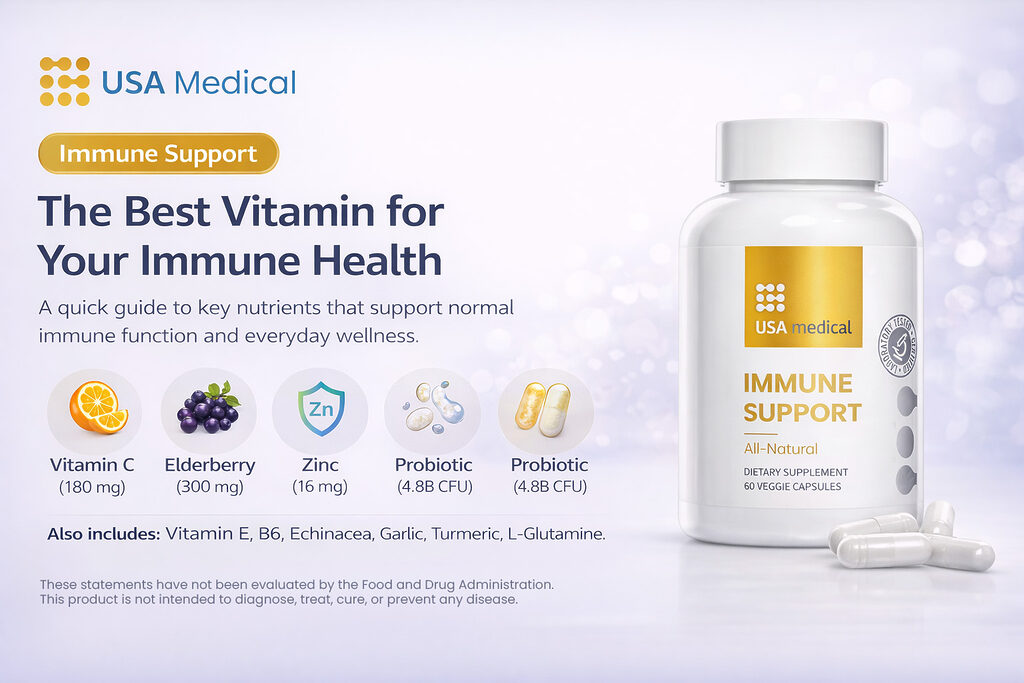
Vitamins and minerals don’t act like antibiotics, but they do support normal immune processes, especially when intake is inconsistent. Below are the core nutrients featured in USA Medical Immune Support Capsules, along with what the research generally suggests.
Vitamin C: antioxidant + immune cell support
Vitamin C for immunity is often discussed because it supports normal immune function and acts as an antioxidant.
When you’re sick, vitamin C won’t “turn off” a virus, but adequate intake supports the basics your immune system uses every day.
In USA Medical Immune Support Capsules, vitamin C is listed as 180 mg (ascorbic acid). This is a straightforward dose commonly seen in immune-focused formulas.
Mini takeaway: Vitamin C is a helpful foundational nutrient, especially if fruit/veg intake is low, but it’s not a stand-alone solution.
Zinc: small mineral, big responsibility
Zinc immune function matters because zinc is involved in many immune processes, and researchers have studied zinc (especially lozenges/syrups) for common cold symptom duration with mixed-to-moderate results depending on form and timing/
Zinc is also essential for general immune health, particularly if someone’s intake is low.
In USA Medical Immune Support Capsules, zinc is listed as 16 mg (zinc oxide).
Mini takeaway: Zinc is a legit “core” mineral for immune basics, but more isn’t always better, long-term high intakes can cause problems (talk with a clinician if you’re already using zinc in other products).
Vitamin E and B6: supportive roles that are easy to overlook
Vitamin E antioxidant support is one reason vitamin E stays on the immune-health radar. Vitamin E acts as an antioxidant in the body, helping protect cells from oxidative damage.
In the formula, vitamin E is listed as 20 mg (alpha-tocopheryl acetate).
Vitamin B6 immune system support is also worth mentioning: Vitamin B6 is involved in many enzyme reactions and is linked with immune function.
In the formula, vitamin B6 is listed as 3.4 mg (pyridoxine HCl).
Mini takeaway: Vitamin E and B6 aren’t as trendy as vitamin C, but they’re part of the “quiet foundation” that supports normal immune function.
Beyond vitamins: botanicals, amino acids, and gut support
This is where immune supplements get interesting, and where it’s especially important to separate promising from proven.
The NIH and NCCIH repeatedly emphasize that evidence varies by ingredient, product, and study quality.
What’s inside USA Medical Immune Support Capsules
Here’s the ingredient lineup you provided, listed as on the label:
- Vitamin C (Ascorbic acid) , 180 mg
- Vitamin E (Alpha-tocopheryl acetate) , 20 mg
- Vitamin B6 (Pyridoxine hydrochloride) , 3.4 mg
- Zinc (Zinc oxide) , 16 mg
- L-Glutamine hydrochloride , 200 mg
- Black elderberry extract (Sambucus nigra) , 300 mg
- Purple coneflower powder (Echinacea) , 200 mg
- Garlic powder (Allium sativum) , 100 mg
- Turmeric root powder (Curcuma longa, 95% curcuminoid) , 100 mg
- Lactobacillus Acidophilus , 4.8 Billion CFU
This combination approach is designed to support multiple angles, nutrients, botanicals, and the gut-immune connection, rather than relying on a single ingredient.
Botanicals: elderberry, echinacea, garlic, turmeric
Elderberry extract is popular for seasonal wellness, and some preliminary research suggests it may help relieve symptoms in certain viral respiratory illnesses, but the evidence remains limited, and larger trials are needed.
Your formula lists 300 mg black elderberry extract (Sambucus nigra).
Echinacea supplement evidence is mixed. A Cochrane review found that the overall evidence for clinically meaningful effects is weak, and results depend heavily on the echinacea preparation used.
Your formula includes 200 mg purple coneflower (echinacea) powder.
Garlic is widely marketed for immune “boosting,” but NCCIH notes there’s very little high-quality research specifically on garlic supplements for immune support, and existing reviews have limitations.
Your formula includes 100 mg of garlic powder.
Turmeric curcumin is often discussed for its anti-inflammatory and antioxidant activity. NCCIH notes turmeric/curcumin products are generally considered likely safe short term for many people, but side effects and medication interactions are possible.
Your formula includes 100 mg turmeric root powder (95% curcuminoid).
Mini takeaway: Botanicals can be beneficial for some people, but they’re not guaranteed to prevent, and safety/interactions matter.
L-Glutamine: an amino acid with immune ties (but not a cure-all)
Glutamine is used by immune cells and plays a role in immune cell activity in research settings.
That said, whether glutamine supplementation meaningfully helps generally healthy adults “get sick less” remains an open question, and benefits may depend on context (e.g., severe stress, intense training, or clinical settings).
Your formula includes 200 mg L-glutamine hydrochloride.
Mini takeaway: Glutamine is biologically relevant to immune metabolism, but outcomes from supplementation can vary by person and situation.
Probiotics and the gut–immune connection
The gut is a major immune organ, and probiotics are studied for a range of effects, yet results can be inconsistent, and safety depends on the individual.
NCCIH notes that risk of harmful effects from probiotics is greater in people who are severely ill or immunocompromised.
Probiotics for immune health may be most relevant if you’re thinking about barrier support, microbiome resilience, or immune signaling through the gut, yet it’s still a “right strain, right person, right situation” conversation.
Your formula includes Lactobacillus Acidophilus (4.8 billion CFU).
Mini takeaway: Probiotics can be helpful, but they’re not one-size-fits-all, especially if you have immune suppression or complex medical conditions.
Using supplements safely (plus the non-negotiable lifestyle pillars)
Supplements can be part of your plan, but immune health still leans hardest on daily behaviors.
The NIH emphasizes that eating a varied, nutritious diet is a primary way to get immune-supporting nutrients, with supplements potentially useful for gaps, not as a replacement.
Here are practical safety checkpoints:
- Avoid “stacking” duplicates. If you take a multivitamin plus an immune formula plus separate zinc/vitamin C, totals can climb fast.
- Check interactions. Garlic and turmeric/curcumin can interact with some medicines, and NCCIH advises caution depending on your health situation and medications.
- Be extra careful if you’re immunocompromised. Probiotics may carry higher risk in high-risk individuals.
- Use the label as your guide. Follow the product’s directions and talk with a clinician if you’re pregnant, breastfeeding, have chronic conditions, or take prescriptions.
To round things out, here are the lifestyle pillars that consistently support immune readiness:
- Sleep regularity
- Balanced diet (fiber, protein, colorful plants)
- Regular movement
- Stress management practices you can actually stick to
- Staying current on recommended preventive care
When to seek medical care: Don’t “supplement through” serious symptoms. Get prompt care for trouble breathing, chest pain/pressure, confusion, fainting, dehydration, or symptoms that rapidly worsen or don’t improve.
Bottom line: Supplements can support a strong foundation, but they work best when paired with consistent lifestyle habits and smart safety checks.
FAQ
1) What is the “best” vitamin to take for immune health?
There isn’t a single winner, but Vitamin C for immunity and Zinc immune function are two of the most commonly discussed foundations because both nutrients play roles in normal immune processes (and zinc has been studied for cold symptom duration in certain forms).
2) Are vitamin E and B6 actually relevant for immunity?
Yes, just less trendy. Vitamin E antioxidant activity helps protect cells from oxidative damage, and Vitamin B6 immune system involvement shows up in its role in immune function and enzyme reactions.
3) Is elderberry worth taking?
Elderberry extract has some preliminary evidence for symptom relief in certain respiratory infections, but overall certainty is still limited and results vary by study quality and product.
4) Does echinacea prevent colds?
Evidence is mixed. An Echinacea supplement may help some people in some studies, but a major review found the overall evidence for clinically meaningful effects is weak and highly dependent on the specific preparation.
5) Do probiotics help the immune system?
Sometimes. Probiotics for immune health is a reasonable concept because gut microbes interact with immune signaling, but study results are inconsistent, and higher-risk individuals should be cautious.
6) Are turmeric and curcumin safe for everyone?
Not always. Turmeric curcumin products are often considered likely safe short-term for many people, but side effects and medication interactions can occur, especially if you take blood thinners or have certain health conditions.
7) Who should talk to a clinician before using immune supplements?
People who are pregnant or breastfeeding, those with autoimmune disease, anyone on immunosuppressive therapy, and people taking multiple prescription meds should check in first, especially if the product includes botanicals or probiotics.
8) What symptoms should never be ignored?
Seek urgent care for severe shortness of breath, chest pain/pressure, confusion, fainting, bluish lips/face, or rapidly worsening symptoms. Supplements aren’t an appropriate treatment in these situations.
Works Cited
NIH Office of Dietary Supplements (ODS). “Dietary Supplements for Immune Function and Infectious Diseases.”
Consumer Fact Sheet: https://ods.od.nih.gov/factsheets/ImmuneFunction-Consumer/
Health Professional Fact Sheet: https://ods.od.nih.gov/factsheets/ImmuneFunction-HealthProfessional/
NIH Office of Dietary Supplements (ODS). “Vitamin C , Consumer.”
https://ods.od.nih.gov/factsheets/VitaminC-Consumer/
NIH Office of Dietary Supplements (ODS). “Zinc , Consumer.”
https://ods.od.nih.gov/factsheets/Zinc-Consumer/
NIH Office of Dietary Supplements (ODS). “Vitamin E , Consumer.”
https://ods.od.nih.gov/factsheets/VitaminE-Consumer/
NIH Office of Dietary Supplements (ODS). “Vitamin B6 , Consumer.”
https://ods.od.nih.gov/factsheets/VitaminB6-Consumer/
NIH Office of Dietary Supplements (ODS). “Probiotics , Health Professional.”
https://ods.od.nih.gov/factsheets/Probiotics-HealthProfessional/
National Center for Complementary and Integrative Health (NCCIH), NIH. “Elderberry: Usefulness and Safety.”
https://www.nccih.nih.gov/health/elderberry
National Center for Complementary and Integrative Health (NCCIH), NIH. “The Common Cold and Complementary Health Approaches.”
https://www.nccih.nih.gov/health/providers/digest/the-common-cold-and-complementary-health-approaches
Cochrane. “Echinacea for Preventing and Treating the Common Cold.”
https://www.cochrane.org/evidence/CD000530_echinacea-preventing-and-treating-common-cold
National Center for Complementary and Integrative Health (NCCIH), NIH. “Garlic: Usefulness and Safety.”
https://www.nccih.nih.gov/health/garlic
National Center for Complementary and Integrative Health (NCCIH), NIH. “Turmeric: Usefulness and Safety.”
https://www.nccih.nih.gov/health/turmeric