Last updated: February 1, 2026
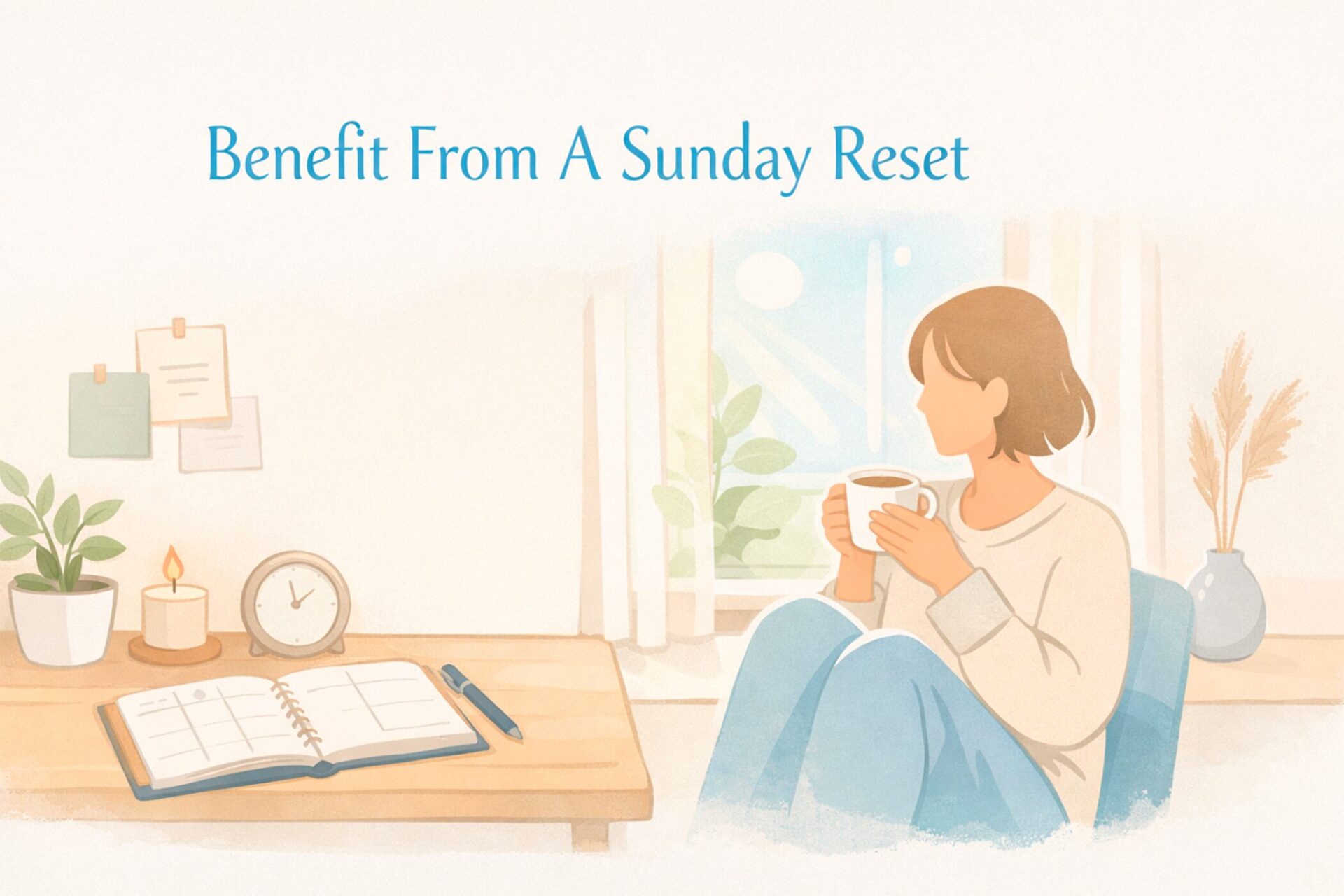
A solid week doesn’t start Monday morning, it starts with how you “close out” Sunday. A good Sunday reset routine reduces decision fatigue, protects sleep, and gives your nervous system a sense of safety and control. The goal isn’t perfection. It’s creating just enough structure that your brain stops spinning and your week feels lighter.
Below is a practical plan for a Sunday reset routine, a gentle Monday morning on-ramp, and simple Monday–Friday habits that support steady energy, calmer regulation, and less stress.
Table of Contents
- The Sunday Reset Blueprint (60–90 minutes)
- An Easy Monday Morning On-Ramp (15–30 minutes)
- Monday–Friday Habits for Low Stress and High Energy
- FAQ
- Works Cited
The Sunday Reset Blueprint
Think of this Sunday reset routine as a “systems check” for your week, home, calendar, food, and mind. Keep it short, repeatable, and kind.
Step 1: Reset your space (10–15 minutes)
Start with one visible area (kitchen counter, entryway, or desk). You’re not deep-cleaning, you’re clearing friction.
To keep it simple, do this quick loop:
- Put obvious items back where they belong
- Clear one surface completely
- Start one load (laundry or dishes) if needed
Closing note: a small reset is enough to signal “fresh start” to your brain.
Step 2: Do quick weekly planning (10 minutes)
weekly planning works best when it’s concrete and minimal. You’re not building a perfect schedule, you’re making Monday feel obvious.
Write down:
- Your top 3 priorities for the week
- One personal “anchor” (workout, friend call, hobby, therapy)
- Known constraints (appointments, deadlines, travel)
Then choose one “first action” for Monday that takes 10 minutes or less. That’s your runway.
Step 3: Set up healthy meal prep (20–30 minutes)
healthy meal prep doesn’t have to be a full Sunday cook-up. Aim for mix-and-match building blocks so weekday food feels easy.
Introduce the plan to yourself like this: “I’m prepping ingredients, not complicated meals.”
Choose 2–3 of these:
- Wash/chop veggies (salad, stir-fry, snack box)
- Cook a protein (chicken, beans/lentils, tofu, eggs)
- Make a starch (rice, quinoa, potatoes)
- Prep one “grab-and-go” breakfast option
Wrap-up: when healthy meal prep is simple, you’re more likely to actually use it.
Step 4: Protect sleep hygiene (10–15 minutes)
Your week’s calm is heavily influenced by sleep. The most powerful Sunday move is reinforcing sleep hygiene so Monday doesn’t start in a fog. The CDC recommends habits like consistent sleep/wake times, limiting screens before bed, and avoiding caffeine later in the day.
A quick Sunday night checklist:
- Set a consistent bedtime/wake time target (even within a 60–90 minute range)
- Power down screens at least 30 minutes before sleep
- Avoid heavy meals and alcohol close to bedtime
Close this step by setting out what you need for Monday (keys, outfit, bag). That tiny “future you” favor reduces morning stress.
Step 5: Downshift with a mindfulness practice (5–10 minutes)
A short mindfulness practice helps your body exit “doing mode.” You’re training your attention to return to the present, which can reduce stress reactivity over time.
Try one:
- 10 slow breaths (longer exhale than inhale)
- A 5-minute body scan in bed
- A “brain dump” journal: write worries, then write next steps (if any)
End the Sunday reset with one sentence: “I’m prepared enough.”
Takeaway: This Sunday reset routine works because it reduces choices, supports sleep hygiene, and creates a clear Monday first step through weekly planning.
An Easy Monday Morning On-Ramp
Your Monday morning on-ramp should feel like easing onto a highway, not merging at full speed. The aim is steady energy and a calmer nervous system.
The 15–30 minute Monday starter
Introduce this routine with one idea: “First I regulate, then I accelerate.”
- Morning sunlight (2–10 minutes)
Get outside if you can—bright light exposure after waking supports your circadian rhythm and alertness. Even a short dose of morning sunlight can help your brain register “daytime.” (If weather or schedule blocks it, stand by a bright window.)
- Hydration habits (1–2 minutes)
Start with water before caffeine. hydration habits matter because even mild dehydration can make you feel more tired.
- One-minute plan (1–3 minutes)
This is weekly planning in miniature: write your “today top 1,” plus the next physical action (send the email, open the document, pack the lunch).
- Movement breaks… early (2–5 minutes)
Do a quick stretch, walk, or mobility flow. Starting the day with movement breaks (even tiny ones) reduces stiffness and can improve mood.
- Start with a “quick win” (5–10 minutes)
Choose something easy and visible: clear your inbox triage, outline the task, or prep your workspace. That’s the psychological magic of a good monday morning on-ramp.
Takeaway: A gentle Monday morning on-ramp built on morning sunlight, hydration habits, and a small “quick win” makes Monday feel manageable instead of chaotic.
Monday–Friday Habits for Low Stress, High Energy, Calm Regulation
These habits are designed to support stress management without requiring a total lifestyle overhaul. Pick 2–3 to start.
1) Keep sleep hygiene boring and consistent
Consistency is the secret sauce of sleep hygiene: similar sleep and wake times, a short wind-down, and less evening stimulation. The CDC highlights routine, limiting electronics before bed, and avoiding caffeine later as helpful strategies.
Simple weekday rule: “Protect the last 30 minutes before bed.”
2) Use movement breaks to prevent energy crashes
Schedule movement breaks like meetings, small doses add up. Try:
- 2–3 minutes every hour
- 10 minutes mid-morning and mid-afternoon
- A short walk after lunch
Close this habit with a reminder: “I’m not exercising; I’m resetting my body.”
3) Practice stress management in “micro-moments”
Good stress management isn’t only meditation retreats. The American Psychological Association includes strategies like moving your body, getting quality sleep, and practicing relaxation/mindfulness.
Try a 20-second reset:
- Drop shoulders
- Unclench jaw
- Exhale slowly (twice)
Repeat this before calls, meetings, or transitions.
4) Make mindfulness practice ridiculously doable
A daily mindfulness practice can be short and still meaningful. Evidence summaries note mindfulness and meditation can help reduce stress symptoms for some people.
Two easy options:
- 3 mindful breaths before you open your laptop
- 5 minutes of guided meditation while you make coffee
If your mind wanders, that’s normal, you’re practicing returning, not staying perfect.
5) Lock in hydration habits with a “when-then” cue
Instead of aiming for a perfect number, build hydration habits around routines:
- When you wake → then drink water
- When you sit down to work → then take 5 sips
- When you eat lunch → then refill your bottle
Harvard notes fatigue can be an early sign of dehydration, and fluids help maintain energy.
6) Keep healthy meal prep small, but strategic
Weekdays get easier when healthy meal prep supports the moments you’re most likely to skip food or grab ultra-processed snacks.
Aim for:
- One protein option
- One vegetable option
- One quick breakfast option
That’s enough for repeatable lunches and steadier energy. healthy meal prep is about reducing friction, not becoming a chef.
If you can, get morning sunlight again Tuesday–Friday. Pair it with something you already do (walk the dog, grab coffee, take out trash). It’s a tiny habit with outsized impact on feeling awake and “online.”
Takeaway: The most sustainable week is built on small repeats: sleep hygiene, movement breaks, hydration habits, and a brief mindfulness practice that supports real-life stress management.
FAQ
1) How long should a sunday reset routine take?
A sunday reset routine can work in 45–90 minutes. Shorter is often better because it’s repeatable.
2) What if I hate planning—do I still need weekly planning?
Yes, but keep weekly planning to 10 minutes: top 3 priorities, key appointments, and one Monday “first action.”
3) What’s the easiest monday morning on-ramp if I’m always rushed?
A simple monday morning on-ramp is: morning sunlight for 2 minutes, water for hydration habits, and one written “top task.”
4) Which habit helps energy the fastest: sleep hygiene, hydration habits, or movement breaks?
Most people notice the quickest boost from hydration habits and movement breaks, while sleep hygiene delivers the biggest long-term payoff.
5) How do I make mindfulness practice stick when I’m distracted?
Make mindfulness practice tiny (1–5 minutes) and attach it to an existing cue (before coffee, after brushing teeth).
6) How do I keep stress management from feeling like another chore?
Use “micro” stress management, one slow exhale before transitions, a short walk, or a brief pause before responding to messages.
7) What’s the most minimal healthy meal prep that still helps?
Minimal healthy meal prep: cook one protein and wash/chop one veggie. That alone improves weekday lunches.
8) Is morning sunlight still useful if it’s cloudy or winter?
Yes, morning sunlight exposure is still helpful even when it’s not bright and sunny; going outside is typically brighter than indoor lighting.
Works Cited
- Centers for Disease Control and Prevention. “About Sleep” (sleep habits and recommendations).
- Centers for Disease Control and Prevention / NIOSH. “Tips to Improve Your Sleep When Times Are Tough.”
- American Psychological Association. “11 Healthy Ways to Handle Life’s Stressors.”
- National Center for Complementary and Integrative Health. “Meditation and Mindfulness: Effectiveness and Safety.”
- MedlinePlus. “Relaxation techniques for stress.”
- Harvard Health Publishing. “Fight fatigue with fluids.”
- Harvard Health Publishing. “Sleep hygiene: Simple practices for better rest.”