

Stress, Brain Fog & Pain: How CBG May Help
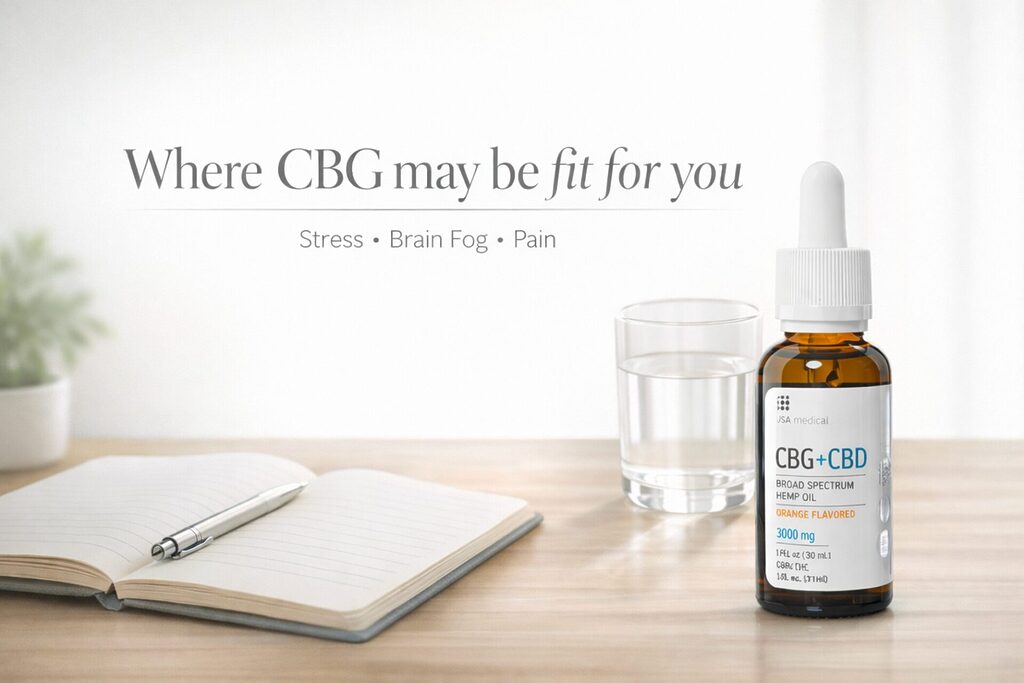
Last updated: January 27, 2026
Most people think “having a tough week” is just bad luck or a packed calendar. But often, what’s really happening is a chain reaction inside the body: a tense mind, a wired nervous system, low-grade inflammation, poor recovery, and mental “static” that makes everything feel harder than it should. When this pattern repeats, it can chip away at focus, mood, motivation, and physical output, day after day.
If you’re dealing with a missing calm mood, struggling to stay on top of tasks, or feeling like your body can’t “reset,” you’re not alone. And it’s why many people are curious about hemp-derived compounds like cannabigerol, often called CBG, which may support relaxation, comfort, and cognitive clarity for some individuals, based on early evidence.
Table of Contents
- The “no reset” problem: why symptoms stack up
- How stress and inflammation drain your day and your week
- How CBG may fit into real-life routines (without overpromising)
- Safety notes and red flags
- FAQ
- Works Cited
1) The “No Reset” Problem: Why Symptoms Stack Up
When your brain and body are under pressure, you don’t just feel one thing. You often feel a cluster: tension, irritability, poor sleep, soreness, digestive upset, and the sense that you’re always behind. Stress hormones are designed to help you respond to challenges, but when stress becomes constant, the body can stay in “on” mode longer than it should.
Here’s what that looks like in real life:
- Your nervous system stays keyed up, making it harder to access a calm mood even when nothing is “wrong.”
- Your muscles stay tight, which can amplify aches and contribute to muscle recovery taking longer.
- Your thinking gets noisier and slower, and brain fog becomes a daily speed bump.
- Discomfort can flare more easily, making pain management feel like a constant background task.
That “I can’t get back to baseline” feeling is often about disrupted homeostasis, your body’s ability to keep internal systems steady and resilient. The goal isn’t perfection; it’s flexibility: ramp up when needed, then return to baseline afterward.
Where CBG enters the conversation: Some early research suggests cannabigerol interacts with multiple signaling pathways related to stress response, inflammation, and discomfort, though human evidence is still emerging and varies by outcome.
Takeaway: If you feel like your week is one long “stress hangover,” it may be less about willpower and more about your system struggling to restore balance.
2) How Stress and Inflammation Drain Your Day and Your Week
Stress is not just a feeling, it’s a full-body state. In the short term, it can sharpen alertness. But chronic stress can keep muscles tense, disrupt sleep, and increase wear-and-tear on recovery systems.
Stress → inflammation → slower recovery
A large body of research links prolonged stress with increased inflammatory signaling in the body and brain. Over time, that can influence energy, mood, and the sensation of fatigue.
This matters because inflammation isn’t inherently “bad”, it’s part of healing. The problem is when you need targeted inflammation for repair, but instead you get persistent background inflammation that drags down performance. That’s the difference between soreness that resolves and soreness that lingers.
This is also where people start looking for inflammation support, not as a magic fix, but as one piece of a bigger plan that includes sleep, movement, stress skills, and medical evaluation when needed.
Brain fog is often a body signal, not a character flaw
brain fog isn’t a diagnosis, but it’s a real experience, especially when pain, stress, and poor sleep overlap. Research on people living with chronic pain describes “brain fog” as a meaningful, disruptive symptom that can affect memory, word-finding, and concentration.
When your mind feels slower, your productivity drops in predictable ways:
- Tasks take longer than they should.
- You reread the same sentence repeatedly.
- You avoid complex decisions and default to “easy wins.”
Pain and muscle fatigue change behavior (and that changes outcomes)
Pain doesn’t only hurt, it changes how you move, how you sleep, and how you plan your day. MedlinePlus notes that mood and stress can make chronic pain worse, and chronic pain can contribute to fatigue and sleep problems.
So pain management is often a performance issue as much as a comfort issue. If discomfort makes you sleep lightly, skip workouts, or sit stiffly all day, you’re more likely to feel physically “spent” and need extra muscle recovery time.
Takeaway: The pattern is self-reinforcing: stress can raise inflammation, inflammation can worsen discomfort, discomfort can disrupt sleep, and poor sleep intensifies stress. Breaking the loop usually requires multiple levers, not just one.
3) How CBG May Fit Into Real-Life Routines (Without Overpromising)
Let’s keep this grounded: cannabigerol is promising, but it’s not a guaranteed solution, and the research is still developing. A 2024 randomized, placebo-controlled human study found that a single dose of CBG reduced self-reported anxiety and stress in the short term, with generally mild side effects reported.
At the same time, not all studies align across outcomes, and some preclinical work has not supported benefits for certain inflammation-related pain models, highlighting why we shouldn’t assume one-size-fits-all results.
CBG, balance, and the body’s “regulation network”
A major reason people connect CBG to homeostasis is its relationship to the endocannabinoid system, a widespread signaling network involved in regulating processes like stress response, immune activity, and pain modulation.
CBG appears to interact with multiple receptor targets (not only classic cannabinoid receptors), which is part of why researchers are exploring it across many symptom categories.
Practical “instances” people consider using it
If you’re exploring CBG, think in terms of use cases, situations where you want support, rather than expecting it to “fix everything.”
1) High-pressure days (presentations, deadlines, social overload)
Some people use CBG for stress relief when they feel keyed-up and want to feel more steady without feeling “high” (CBG is typically described as non-intoxicating). Human evidence is early but suggests short-term reductions in anxiety-like feelings for some participants.
If you try it, consider pairing stress relief strategies (breathing, a short walk, hydration) so you’re not relying on one tool.
2) Weeks when your body feels “inflamed and stuck”
If you’re looking for inflammation support, the most reliable foundation is still sleep, nutrition, movement, and addressing underlying conditions. CBG is being studied for anti-inflammatory potential, but most findings are preclinical or mechanistic rather than definitive clinical proof.
Used thoughtfully, it may be something some adults experiment with as a supplemental layer of inflammation support, not a replacement for medical care.
3) Cognitive drag and workload overload
When brain fog shows up, it often rides alongside stress, pain, or poor sleep. Some CBG research has looked at mood, stress, and cognition in the acute setting, but “clear thinking” outcomes are still not settled.
If you’re using CBG here, treat it as a trial with a journal: track sleep quality, workload, caffeine, and symptom intensity so you can tell what’s actually changing.
4) Discomfort that disrupts sleep or movement
Many consumers report using CBG for comfort, but strong human clinical evidence for pain management is still limited and mixed.
If you try it for pain management, be cautious about product quality and realistic expectations, and prioritize evaluation if pain is persistent or worsening.
5) Post-activity soreness and feeling “wrecked”
If you train hard, travel, or do physical work, you might be chasing better muscle recovery. Some people experiment with CBG in recovery routines, especially when tension and sleep disruption are part of the picture. Just keep in mind: recovery is mostly built on sleep, protein/energy adequacy, smart training load, and stress reduction. CBG, often as CBG oil, is best framed as optional support, not the main engine.
How people typically take it (forms and routine)
You’ll commonly see CBG oil (tinctures), capsules, and gummies. If you choose CBG oil, focus on:
- Third-party testing (COA) for potency and contaminants
- Clear labeling of cannabinoids per serving
- Avoiding exaggerated disease claims (a red flag)
Close your experiment loop: if you don’t notice meaningful change after a reasonable trial, that information is useful, and it may be time to adjust sleep, stress tools, or talk with a clinician about underlying drivers.
Takeaway: CBG is best approached as a “supporting actor.” Some people use it for stress relief, some for comfort, and some for sleep-adjacent recovery, but expectations should match the current evidence.
FAQ
1) What is cannabigerol, and is it the same as CBD?
cannabigerol (CBG) and CBD are different cannabinoids found in hemp/cannabis. CBG is often described as non-intoxicating, and research is still developing on what it may help with.
2) Can CBG oil help with stress relief before a big event?
Some early human research suggests CBG may reduce anxiety- and stress-related feelings acutely, which is why people consider CBG oil for stress relief in short-term situations. Results vary, and it’s not a substitute for therapy, sleep, or medical care.
3) Is CBG good for inflammation support?
CBG is being studied for anti-inflammatory effects, but much of the evidence is preclinical. If you use it, treat inflammation support as a broader plan (sleep, movement, nutrition, medical evaluation) with CBG as optional.
4) What about brain fog, does CBG improve focus?
The data on brain fog specifically is limited. Some studies look at mood, stress, and cognitive measures in the short term, but “focus” outcomes aren’t settled. Track sleep and stress alongside any trial.
5) Can CBG replace pain management medications?
CBG should not replace prescribed pain management treatments without a clinician’s guidance. Evidence for pain outcomes is mixed, and persistent pain deserves medical evaluation.
6) Does CBG support muscle recovery after workouts?
People sometimes use CBG as part of muscle recovery, especially if stress and sleep disruption are limiting recovery. But the strongest drivers remain training load, sleep, and nutrition.
7) How does the endocannabinoid system relate to homeostasis?
The endocannabinoid system helps regulate many processes tied to internal balance, including stress response and immune signaling, key components of homeostasis. This is one reason cannabinoids are being studied for broad wellness applications.
8) What’s the safest way to try CBG oil?
Choose reputable CBG oil with third-party testing, start with the lowest labeled serving, and avoid combining with other sedating substances. If you take prescriptions or have liver disease risk factors, talk with a clinician first.
Works Cited
- NIH MedlinePlus , Stress overview (updated 2023)
- NIH MedlinePlus , Stress and your health (updated 2024)
- NIH MedlinePlus , Chronic pain overview (updated 2025)
- Peer-reviewed review on stress and inflammation (PubMed Central)
- Scoping review on cognitive symptoms in chronic pain (PubMed Central)
- Peer-reviewed CBG mechanisms and therapeutic potential review (PubMed Central, 2024)
- Human placebo-controlled CBG study on anxiety/stress/mood (PubMed Central, 2024)
- NIH NCCIH , Cannabis/cannabinoids safety overview
- U.S. FDA , Regulation of cannabis-derived products / warning against illegal claims