Last updated: January 18, 2026
Table of Contents
To help you jump to what you need, here’s what we’ll cover:
- Why your week starts before Monday
- Regulated > motivated (and why it matters)
- Choosing one daily anchor
- A simple Sunday-to-Monday plan
- When to loop in a clinician
- FAQ
Use this as a menu, then come back and re-read the section that feels most useful.
Most of us don’t need a stricter Monday routine, we need a calmer on-ramp. When your week begins with a little physical ease and less mental clutter, it’s easier to make steady choices without white-knuckling your way through. This article is educational and not medical advice; if you have health concerns, a clinician can help you personalize next steps.
The weekly reset: clear the body, clear the mind
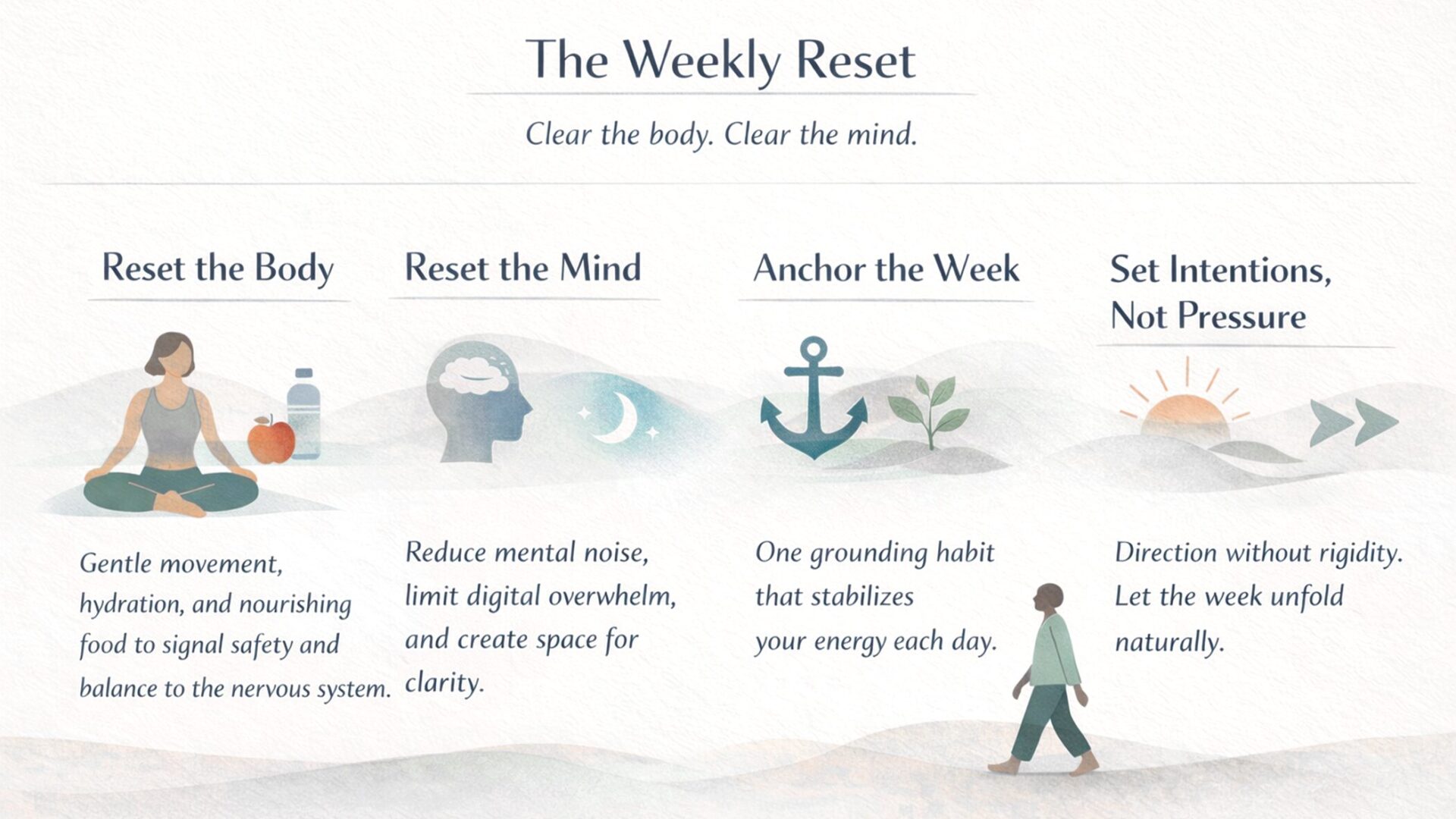
The core idea is simple: your week starts before Monday. If you wait until the alarm goes off to “get it together,” you’re starting from pressure. A Sunday (or end-of-day) reset works because it removes friction before you ask yourself to perform.
Signal safety first: movement + breath
If your body feels tense or wired, it’s hard to “think” your way into focus. A few minutes of light movement, like an easy walk, gentle stretching, or a slow mobility flow, followed by breathwork can act like a physiological downshift. Research suggests certain breathing practices can support parasympathetic activity (the “rest-and-digest” side of your nervous system), which may help counter stress reactivity. And even modest physical activity can reduce short-term feelings of anxiety for many adults.
One simple food choice that supports digestion early in the week
Pick one “easy win” food choice that supports digestive health: add a fiber-rich item to your first meal on Monday (or your first meal after the weekend). Think oats, beans, berries, chia, nuts, or extra vegetables, nothing fancy, just consistent. Dietary fiber helps digestion and can help prevent constipation, but it’s best to increase it gradually if you’re not used to it.
Reduce mental noise before you add productivity
Overwhelm usually isn’t a time-management problem, it’s a “too many open tabs” problem. Before you add goals, reduce mental noise.
Try this quick mental declutter:
- Do a 2-minute brain dump (everything that’s looping in your mind)
- Circle the top 1–3 items that truly matter this week
- Pick one “not-to-do” boundary (one thing you’re allowed to postpone)
When you close the loop on what’s noisy, the rest of the week feels less like a grind and more like a sequence of small decisions.
Section takeaway: A reset works best when it starts with the body (ease), supports the gut (simplicity), and clears mental clutter (space).
Start the week regulated, not motivated
“Motivation fades. Regulation carries you through.”
That’s not a pessimistic take, it’s a practical one. Motivation is a spike; regulation is a base. When your baseline is steadier, your choices get easier to repeat.
The goal is nervous system regulation: shifting from “threat mode” (rushed, reactive, scattered) toward a calmer, more organized state where follow-through is realistic.
Sleep: protect the most powerful mood lever
A supportive sleep routine doesn’t need to be perfect to matter. Consistency helps: going to bed and waking up around the same time, keeping the bedroom quiet and cool, turning off devices shortly before bed, and avoiding heavy meals, alcohol, or late caffeine can all support better sleep quality.
If sleep has been rough, start with the smallest change you can keep for a week, like a fixed “screens-down” time or a consistent wake time. Your brain loves predictability.
Hydration: reduce avoidable strain
Steady hydration habits are a low-effort way to reduce physical stress that can masquerade as mental fatigue. Dehydration can show up as thirst, dry mouth, darker urine, tiredness, brain fog, or dizziness.
You don’t need to obsess over ounces. A simple cue-based approach, drink water with meals, keep a bottle visible, and notice your urine color, often improves consistency without turning it into a chore.
Light: set your internal clock (and your mood)
Your body uses light exposure to help set circadian timing, which influences sleepiness and alertness. As daytime light increases, biological signals promote wakefulness; stable rhythms tend to support more restorative sleep. Bright light during the day, especially morning sunlight, can be particularly helpful for anchoring this pattern.
If you’re mostly indoors, even stepping outside briefly can be a meaningful signal. If mornings are hectic, pair this with something you already do (take the trash out, let the dog out, grab your coffee outside for a minute).
Section takeaway: Calm focus beats hype. When sleep, water, and daylight are steadier, your mind tends to follow.
One anchor habit that grounds the whole week
You don’t need a complicated routine, just an anchor habit. Think of it as one small action that “sets the tone” most days, even when everything else is messy.
An anchor habit works because it reduces decision fatigue. Instead of wondering how to start your day (or end it), you have a default. Defaults are powerful.
Here are a few anchors that many people find doable:
- Step outside for morning sunlight, then take a short, easy walk
- Keep a consistent first meal on weekdays (simple, repeatable, not perfect)
- Do a 10-minute evening wind-down that supports your sleep routine (dim lights, screens away, light reading, or a warm shower)
Pick one and keep it boring. Boring is what makes it repeatable.
If your anchor is morning-based, consistent light exposure across the week can help your body predict “daytime is on,” which often supports better evenings too.
Section takeaway: Simplicity wins. One steady anchor can make the whole week feel more stable.
A simple Sunday-to-Monday reset plan
If you like structure, here’s a repeatable plan that takes about 15 minutes. The point isn’t to become a new person by Monday, it’s to lower the friction that makes Monday feel heavy.
Here’s a quick reset you can copy-paste into your weekend:
- 2 minutes: Sit down and do breathwork (slow inhale, longer exhale, relaxed shoulders)
- 5 minutes: Do light movement (walk, stretch, or gentle yoga, keep it easy)
- 3 minutes: Prep one Monday-friendly choice for digestive health (wash fruit, portion oats, or prep veggies)
- 2 minutes: Set up hydration habits (fill a bottle, place a glass by the sink, or set a simple reminder)
- 2 minutes: Brain dump + circle your top 1–3 priorities
- 1 minute: Add one “friction reducer” (lay out clothes, pack a bag, clear a counter)
Done consistently, this turns Monday from a cliff into a ramp.
On Monday morning, keep your first 10 minutes gentle: no news scroll, no inbox triage. Start with your anchor, then one easy task to build momentum.
FAQ
Q: What if a weekly reset feels impossible on Sundays?
A: Make it smaller and move it. A 5-minute “reset” on Monday night or Wednesday afternoon still reduces friction. Consistency matters more than the calendar.
Q: How do I choose an anchor habit I’ll actually keep?
A: Choose the one that feels almost too easy. Tie it to something you already do, and aim for “most days,” not perfection.
Q: What does nervous system regulation look like in real life?
A: It looks like fewer reactive choices: slightly steadier mood, less urgency, and a greater ability to pause before you respond—especially when the week gets busy.
Q: Does morning sunlight still help if it’s cloudy or I only have a few minutes?
A: Usually, yes. Outdoor daylight tends to be brighter than indoor light, even on overcast days. Short, consistent exposure is often more useful than occasional long sessions.
Q: Is light exposure only about sleep?
A: No. Daytime brightness can influence alertness and timing cues throughout the day. Sleep is a major outcome, but many people also notice a steadier daytime rhythm.
Q: What’s a realistic sleep routine if my schedule changes week to week?
A: Pick one “non-negotiable” you can keep: a consistent wake time, a short wind-down, or a device cutoff. One stable piece can help the rest fluctuate less.
Q: How do hydration habits fit with coffee or tea?
A: Caffeinated drinks can count toward fluids for many people, but they don’t always replace plain water well. If caffeine makes you jittery or disrupts sleep, adjust timing and balance it with water.
Q: What kind of breathwork is simplest if I get anxious?
A: Keep it basic: slow, comfortable breathing with a longer exhale than inhale. If breathing exercises worsen anxiety, stop and try grounding (feet on floor, name 5 things you see) instead.
Q: Does light movement “count” if I’m sore or have joint pain?
A: It can. The goal is gentle circulation and a downshift, not intensity. If pain is sharp, new, or worsening, it’s worth getting medical guidance.
Q: What if digestive health is already a struggle (like IBS)?
A: Start conservatively and avoid sudden big changes. If symptoms are persistent or severe, a clinician or registered dietitian can help tailor food choices safely.
Works Cited
The sources below informed the health background in this article:
- CDC. “About Sleep.”
- CDC (NIOSH). “Tips to Improve Your Sleep When Times Are Tough.”
- MedlinePlus. “Relaxation techniques for stress.”
- MedlinePlus. “Dietary Fiber.”
- MedlinePlus. “Dehydration.”
- Sleep Foundation. “What Is Circadian Rhythm?”
- CDC. “Benefits of Physical Activity.”
- Bentley TGK, et al. “Breathing Practices for Stress and Anxiety Reduction.”
These references are a starting point—your clinician can help you apply them to your situation.