Last updated: January 19, 2026
Your Sunday reset can make Monday feel easier, but the real win is carrying that calm momentum through the whole week. The goal isn’t perfection; it’s creating simple “defaults” that keep your body fueled, your mind steadier, and your nights restorative. Below is a practical, holistic approach (with gentle product support ideas) you can repeat every week.
Table of Contents
- The three anchors that make the week feel smoother
- Night protection: the environment and wind-down
- Daytime calm: stress that actually resolves
- Supplements and basics: where they can help
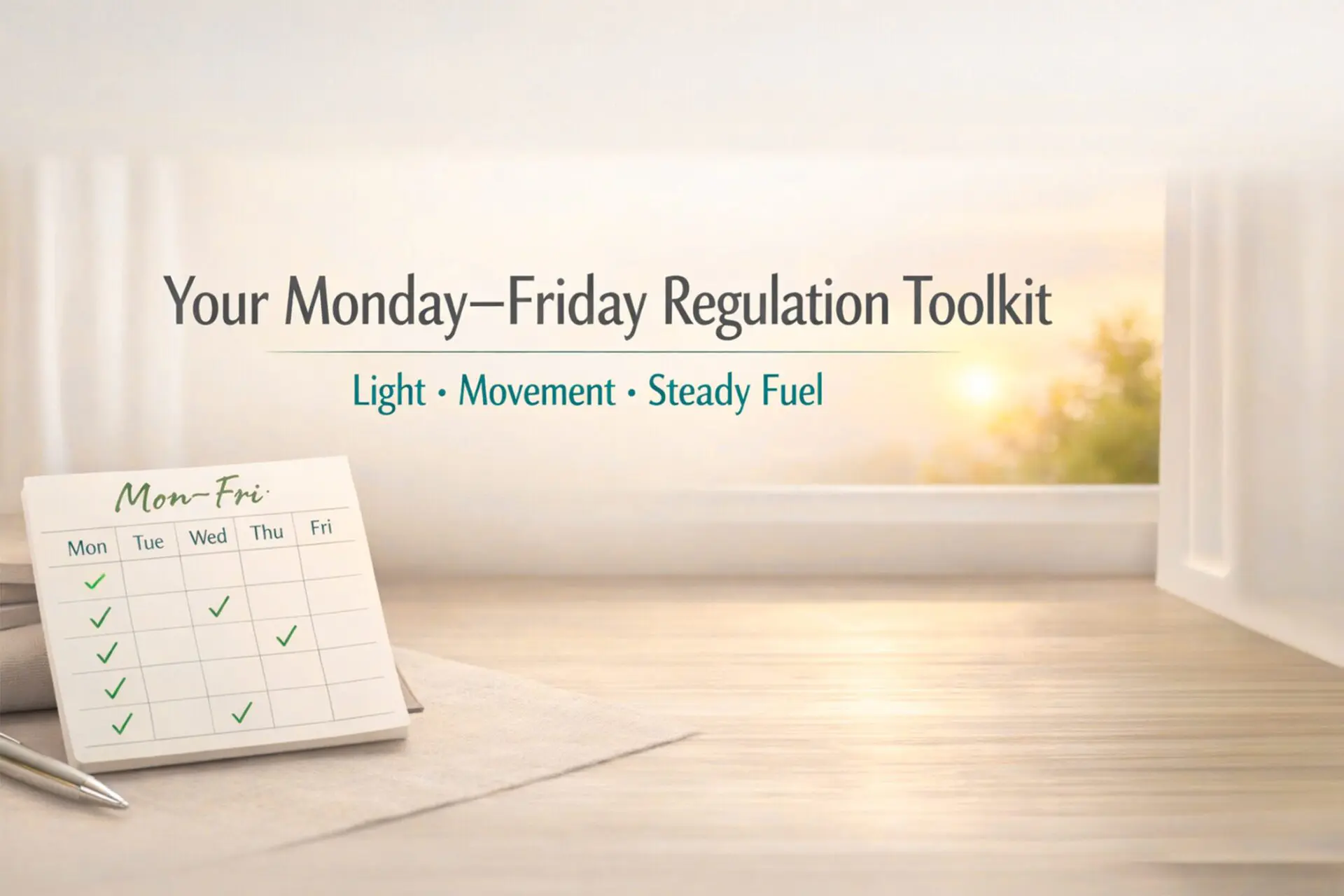
- A Monday–Friday template you can copy
- FAQ
- Works Cited
The three anchors that make the week feel smoother
A good week usually comes down to three repeatable anchors: light, movement, and steady fuel. When those are consistent, everything else (focus, cravings, mood) gets easier.
Anchor 1: Light early, darker later
Getting morning sunlight soon after waking is one of the simplest ways to cue your body clock. That light signal helps set your circadian rhythm, which influences alertness in the day and sleepiness at night. Even a brief, consistent dose can help your brain “time” the day more predictably.
Anchor 2: Small movement, not heroic workouts
Think: a brisk walk, short mobility, or a few strength “snacks” during breaks. Regular movement improves sleep drive and helps buffer stress. If you did a big tidy/plan on Sunday, keep Monday’s movement deliberately small, so it feels doable even on a packed day.
Anchor 3: Steadier fuel for steadier days
Energy swings often track with hydration, caffeine timing, and meal structure. A simple pattern:
- Eat a protein-forward breakfast or brunch if mornings run fast.
- Keep caffeine earlier in the day so it doesn’t crowd your sleep window.
- Build a “3 p.m. rescue” snack (protein + fiber) to reduce late-day cravings.
This is where energy regulation becomes less about willpower and more about routine design.
Section takeaway: If you only nail one thing this week, make it the light + movement + steady fuel trio, because it supports focus and mood without adding more tasks.
Night protection: the environment and wind-down
Adults generally need at least 7 hours of sleep for health and daytime functioning, and many people feel best closer to 7–9. The trick is guarding the hours you already have.
Make your bedroom “boring” (in a good way)
A cool, dark, quiet space helps your brain associate bed with sleep, core sleep hygiene that pays off over time.
Build a wind-down you can repeat
A bedtime routine doesn’t need to be long. It needs to be consistent and calming, so your body stops expecting one more email, one more show, one more task.
Before the list, one key mindset: you’re not “getting ready for bed,” you’re “powering down the day.”
Here’s a simple wind-down checklist you can choose from (pick 3–5 items):
- Dim lights and switch screens to low brightness (or off)
- Warm shower or face wash to mark the transition
- Light stretching or legs-up-the-wall
- A paper book, calming music, or a short guided relaxation
- Write tomorrow’s top 3 priorities on paper (so your brain can stop rehearsing them)
Close the loop by keeping it repeatable, your nervous system learns faster from consistency than from intensity.
Section takeaway: Protecting nights is the fastest way to make mornings feel less effortful, because sleep is when your body does the behind-the-scenes repair work.
Daytime calm: stress that actually resolves
Stress isn’t just “in your head”, it shows up in muscle tension, breathing patterns, digestion, and how reactive you feel. Effective stress management is less about eliminating stressors and more about giving your body frequent chances to come back to baseline.
Use “transition rituals”
Transitions are where stress accumulates: waking → working, meeting → meeting, work → home. Try 30–90 seconds of:
- Slow nasal breathing (longer exhales)
- Shoulder drops + jaw unclench
- A quick outside look at the sky (yes, even from a doorway)
Create a 2-minute “closeout” at the end of work
Write: (1) what you finished, (2) what you’ll do first tomorrow, (3) what can wait. This reduces after-hours rumination and supports better sleep.
Don’t skip recovery micro-breaks
Short breaks help your body process stress hormones and provide real nervous system support, especially on high-demand days.
Section takeaway: Calm isn’t a personality trait; it’s a practice. Small, frequent “downshifts” keep stress from snowballing into insomnia or burnout.
Supplements and basics: where they can help
Lifestyle anchors come first, but products can be useful tools, especially when you’re trying to stabilize a busy week. If you use USA Medical products, think of them as “supporting actors” to your routines, not replacements for them.
USA Medical Products To Support Your Week Regulation:
- Magnesium Glycinate: Magnesium plays roles in muscle and nerve function and many biochemical processes. People often consider it for relaxation and sleep support, especially when stress is high or dietary intake is inconsistent.
- Turmeric: Adding turmeric can help keep your stomach feeling settled and comfortable so your meals stay predictable all week after your Sunday reset. It’s a simple support for steady digestion, which can make your energy and mood feel more even from Monday through Friday.
- Omega-3: Omega-3s can support a steady heart, a clear mind, and smoother-feeling joints so you can stick with your weekly routines without feeling run down. That kind of “quiet support” helps your reset carry through the week, especially on busy days.
Section takeaway: Supplements can be helpful, but they work best when they reinforce the same daily cues—light, timing, wind-down, and recovery.
A Monday–Friday template you can copy
Below is a simple structure you can use the week after your reset. Think of it as a reusable holistic wellness plan, a rhythm, not a rigid schedule.
Morning (10–30 minutes total)
Start with morning sunlight and a small movement habit (walk, mobility, or a few minutes of stretching). Pair it with water and a protein-forward first meal when you can. This keeps attention steadier and reduces the mid-morning “snack spiral.”
Midday (2–10 minutes, twice)
Add two “downshift moments” to support stress resilience:
- One before lunch
- One mid-afternoon (especially if you’re tempted to grab more caffeine)
If you’re using USA Medical wellness products, midday is a good time for hydration or nutrition basics that don’t interfere with sleep later.
Evening (20–45 minutes)
Choose a short bedtime routine and protect the last hour of the day from stressful inputs when possible (heavy work, intense news, heated discussions). If you and your clinician agree it’s appropriate, some people take magnesium glycinate in the evening as part of their wind-down structure (timing varies by individual).
Two quick “week guardrails”
I’m introducing a short list with two guardrails because they’re easy to remember and high-impact:
- Keep caffeine earlier in the day
- Keep wake time fairly consistent, even if bedtime varies a bit
Close the list by remembering the goal: fewer extremes, less wired, less crashed, more steady.
Section takeaway: When your days feel predictable, your body spends less energy “bracing,” which supports better focus, better sleep, and better recovery.
Wrap-up: make it sustainable
The week after the reset works best when you focus on repeatable cues, not perfect execution. When you support your circadian rhythm with consistent light exposure, protect sleep opportunity, and build small recovery breaks, you create conditions for steadier mood and performance. That’s how energy regulation becomes your default instead of your daily struggle, and how your Sunday reset turns into a week-long advantage. This is also real-world nervous system support: frequent signals of safety, not one big “self-care day.” And that’s the point of a holistic wellness plan, simple, repeatable habits you can keep.
FAQ
1) What does good sleep hygiene look like if my week is busy?
Focus on consistency: a regular wake time, a darker/cooler room, and fewer stimulating inputs late evening. If you’re still struggling after a few weeks, consider talking with a healthcare professional to rule out sleep disorders.
2) How do I practice stress management without adding another task?
Attach a 60-second reset to routines you already do—before lunch, after meetings, or when you get in the car. Breathing, stretching, or a quick walk can help bring your body back toward baseline.
3) Is magnesium glycinate better than other forms?
“Better” depends on your goals and tolerance. Some people prefer it because it may be easier on digestion, but reactions vary. Check interactions and safety considerations with your pharmacist or clinician, especially if you take medications or have kidney disease.
4) Does morning sunlight really matter if I work indoors?
It can help cue your body clock, especially when it’s consistent. If outdoor light isn’t possible, bright light near a window soon after waking may still be useful.
5) What’s the minimum bedtime routine that still helps?
Keep it short and repeatable: dim lights, wash up, do a few minutes of calm activity, and keep screens low or off. Consistency is the main ingredient.
6) When should I get help for sleep problems?
Seek care if insomnia lasts more than a few weeks, you have loud snoring or pauses in breathing, severe daytime sleepiness, or sleep issues that affect safety (like drowsy driving).
7) Can supplements replace lifestyle changes for sleep or stress?
They’re best used as add-ons. Start with light exposure, consistent timing, movement, and wind-down habits; then consider products to support the routine—not replace it.
8) What if I feel exhausted but “wired” at night?
That pattern often points to late-day stimulation (stress, screens, caffeine timing) or an inconsistent schedule. Try earlier caffeine cutoff, a lighter evening, and a calming wind-down, and talk to a clinician if it persists.
Works Cited
- NIH Office of Dietary Supplements. “Magnesium — Health Professional Fact Sheet.”
- Centers for Disease Control and Prevention (CDC). “About Sleep.”
- American Academy of Sleep Medicine (AASM). “Healthy Sleep Habits.”
- MedlinePlus. “Healthy Sleep.”
- MedlinePlus. “Changing Your Sleep Habits.”
- MedlinePlus. “Stress / Learn to Manage Stress.”
- National Center for Complementary and Integrative Health (NCCIH). “Stress, Anxiety, and Sleep Problems (eBook).”