Last updated: January 15, 2026
Your digestive tract does a lot more than break down lunch. It’s a major “checkpoint” where your body decides what’s safe, what’s suspicious, and how strongly to react. When you support everyday gut health, you’re also supporting the systems that help you respond to germs and keep inflammation in balance.
Below is a practical, holistic guide built around what tends to help most people: whole foods (especially fiber), smart use of cultured foods, fewer highly processed choices, and calmer mealtimes.
Table of Contents
- Why the digestive tract is an immune hub
- Whole foods that feed your inner ecosystem
- Cultured foods and what they can (and can’t) do
- When highly processed patterns backfire
- Slower meals, calmer signals
- A simple routine you can actually follow
- FAQ
- Works Cited
Why the digestive tract is an immune hub
A striking amount of immune activity happens in the intestines. Scientific reviews commonly describe that roughly 70–80% of immune cells are associated with the gut, largely within gut-associated lymphoid tissue (GALT). That’s why the phrase gut immunity isn’t just wellness hype—it’s a shorthand for a real biological reality.
Here’s the big picture: your intestinal lining is a selective “border.” It has to absorb nutrients while keeping pathogens and irritants from slipping through. Your body supports that border with mucus, tight junctions between cells, and specialized immune defenses that patrol the surface.
This is also where the gut microbiome comes in. Your resident microbes help train the immune system, produce helpful metabolites, and compete with harmful organisms for space and resources. When the ecosystem is diverse and well-fed, it can support a more measured, appropriate immune response.
Section takeaway: Your intestines aren’t separate from immunity—they’re one of its busiest headquarters.
Whole foods that feed your inner ecosystem
If you want one “big lever,” make it plants. Whole foods—vegetables, fruits, beans, nuts, seeds, and whole grains—provide the raw materials your microbes thrive on. A fiber–rich diet is consistently associated with better digestive function and broader health benefits, yet most Americans fall short of recommended intake.
Why fiber matters: many fibers aren’t digested by you—they’re fermented by microbes. That fermentation creates short-chain fatty acids (SCFAs), which help support the gut barrier and immune balance. This is one reason researchers focus on food patterns, not just single nutrients: your daily choices shape microbial function and inflammation signaling.
A helpful concept is prebiotic fiber—certain fibers that selectively “feed” beneficial microbes. To make that practical, here are common food-based sources (introduce them gradually if you’re not used to fiber):
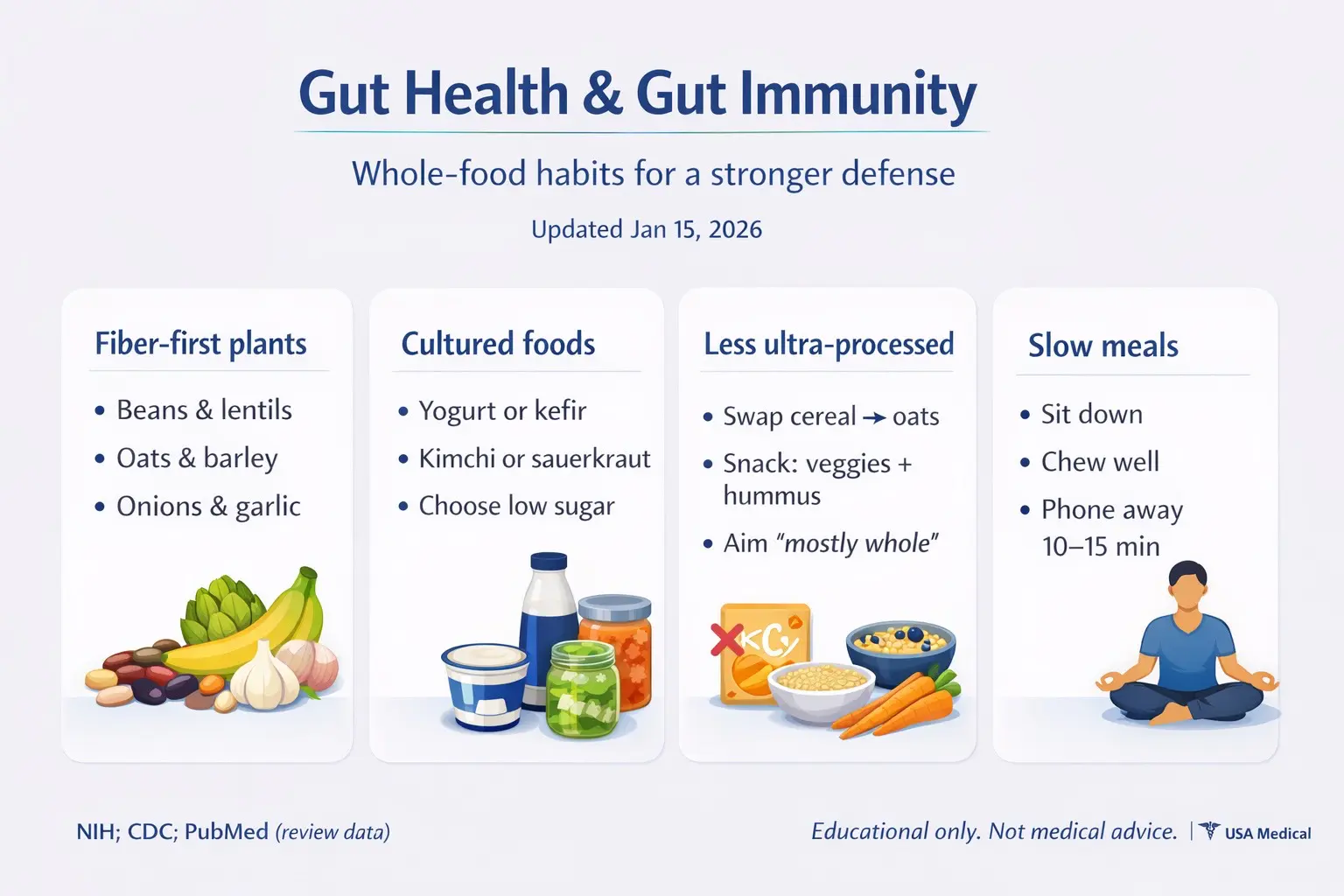
- Beans and lentils
- Oats and barley
- Onions, garlic, and leeks
- Slightly green bananas
- Asparagus and artichokes
If you’re new to prebiotic fiber, start low and go slow (think: add one additional high-fiber food per day, then build). This reduces bloating and helps your system adapt.
Also, don’t forget the basics that help digestion work smoothly: adequate fluids, regular movement, and consistent meal timing.
Section takeaway: Whole plants “feed the helpers” and support the barrier your immune system relies on.
Cultured foods and what they can (and can’t) do
Cultured foods can be a useful add-on for many people. In a well-known human study, a diet higher in fermented items increased microbial diversity and was linked with decreases in several inflammatory markers over a short intervention period. That doesn’t mean they’re magic—but it’s a solid signal that food can influence the microbiome–immune conversation.
In everyday terms, fermented foods include yogurt, kefir, kimchi, and sauerkraut. Many people use these as probiotic foods—foods that may contain live microorganisms (or their byproducts) that interact with your gut environment.
A few practical tips make them more helpful (and more tolerable):
- Choose options with minimal added sugar (sweetened yogurts and drinkables can add up fast).
- Watch sodium, especially with kimchi/sauerkraut.
- Start with small servings, because a sudden jump can cause gas or discomfort.
Also, a key safety note: probiotics aren’t proven to be helpful or safe for everyone, and people with significantly weakened immune systems should talk with a clinician before using probiotic products regularly. To get the most from probiotic foods, consistency matters more than large portions.
Section takeaway: Cultured foods can complement a whole-food pattern, especially when chosen thoughtfully.
When highly processed patterns backfire
It’s not about perfection—it’s about frequency. Diets heavy in ultra-processed foods tend to be lower in fiber and higher in additives, refined starches, and certain fats/sugars that can shift the gut environment. Reviews in gastroenterology literature describe growing evidence linking highly processed dietary patterns and additives with gut dysbiosis and digestive disease risk.
Mechanisms scientists discuss include reduced SCFA production (because there’s less fiber), changes in microbial diversity, and potential effects of some additives on the gut lining and immune signaling. Importantly, this doesn’t mean every packaged food is “bad.” It means that when the majority of your intake is hyper-processed, the pattern can crowd out the foods your gut needs to stay resilient.
A realistic strategy is substitution, not elimination:
- Swap sugary cereal for oats + fruit a few days per week.
- Replace chips with nuts or hummus + veggies sometimes.
- Aim for “mostly whole” at meals, and let convenience foods play a supporting role.
Section takeaway: The goal is to reduce constant exposure to highly processed patterns, not to chase dietary purity.
Slower meals, calmer signals
Your digestion is wired to your nervous system. When you’re rushed or stressed, your body can shift away from “rest-and-digest,” affecting motility, sensitivity, and symptoms. The bidirectional communication between your gut and brain—including the vagus nerve—is part of this story. This is often described as the gut-brain axis.
One evidence-informed approach is mindful eating: bringing attention to hunger/fullness cues, slowing your pace, and reducing distractions. Reviews describe a plausible stress–digestion link and the clinical rationale for mindfulness-based strategies in digestive symptoms. Separate research on eating rate suggests that slowing down can meaningfully change post-meal responses and appetite regulation.
Here’s the practical interpretation of “a calm gut = a calm immune response”: when stress signaling is chronically elevated, the gut-brain axis can amplify gut sensitivity and inflammation-related pathways. Calmer inputs—breathing, pacing, chewing, posture—help your body process food with fewer “alarm bells.”
Section takeaway: Your meals aren’t just nutrients; they’re signals. Slow and steady often supports smoother digestion.
A simple routine you can actually follow
If you want a realistic weekly plan, aim for consistency over intensity. Here’s a framework that supports digestion and helps build gut immunity over time:
First, anchor most meals around whole foods, then add “supporting players.” Aim for a fiber-rich diet on most days: a fruit or vegetable at breakfast, a bean/whole grain at lunch, and two colorful plants at dinner is a strong start.
Second, add cultured items in modest portions. Try fermented foods a few times per week—like a side of yogurt, a splash of kefir in a smoothie, or a forkful of kimchi with a meal.
Third, make “sometimes foods” truly sometimes. Keep ultra-processed foods as occasional convenience rather than the default, especially when they replace plants and protein at meals.
Finally, build calmer mealtimes. Pick one meal a day to practice mindful eating: sit down, chew thoroughly, put the phone away, and take 10–15 minutes. Small changes here can reduce symptoms for many people and support steadier digestion.
These steps are simple, but they’re powerful because they’re repeatable—and repeatability is what improves gut health.
FAQ
What is the gut microbiome, and can I “test” it?
The gut microbiome is the community of microbes living in your digestive tract. Commercial tests can describe what’s there, but results don’t always translate into clear, medical-grade action steps. Most people benefit more from consistent food and lifestyle patterns than from chasing perfect numbers.
How fast can a fiber-rich diet make a difference?
A fiber-rich diet can change microbial activity within days, but the biggest benefits come from weeks to months of consistency. Increase fiber gradually, and pair it with adequate fluids to reduce constipation and bloating.
Are fermented foods safe every day?
For many people, fermented foods are fine in regular small servings. If you’re sensitive to histamine, have severe IBS/SIBO symptoms, or have a compromised immune system, check with a clinician—some probiotic approaches may not be appropriate for everyone.
Do ultra-processed foods always harm digestion?
Not always. The issue is the pattern: ultra-processed foods can crowd out fiber and expose the gut to more additives and refined ingredients. Many people do well when these are occasional, not constant.
Do probiotic foods replace supplements?
Often, no supplement is necessary. Probiotic foods can be a practical, food-first way to experiment, but benefits vary by person and product. If you’re considering probiotic supplements for a condition, it’s worth discussing with a clinician.
What counts as prebiotic fiber?
Prebiotic fiber refers to certain fibers that microbes ferment—commonly from foods like beans, oats, onions, and slightly green bananas. Introduce them gradually and track how your body responds.
Can mindful eating help with bloating?
It can. Mindful eating may reduce swallowed air, improve pacing, and lower stress-related gut sensitivity. It’s not a cure-all, but it’s a low-risk habit that often helps symptom patterns.
What does the gut-brain axis have to do with stress?
The gut-brain axis is the two-way communication network linking digestion, microbes, and the nervous system. When stress is high, signals can shift motility and sensitivity; calming practices may support steadier function.
Works Cited
- Wiertsema SP, et al. Review on intestinal microbes and immune interactions (2021).
- Jung C, et al. Review on Peyer’s patches and GALT immune cells (2010).
- Wastyk HC, et al. Human diet intervention examining microbial diversity and immune markers (2021).
- Stanford Medicine report on cultured-food dietary intervention findings (2021).
- Nature Reviews Gastroenterology & Hepatology: review on highly processed dietary patterns and gut health (2024).
- NIH Research Matters: dietary fiber benefits and intake gap (2022).
- MedlinePlus: dietary fiber overview (updated 2023).
- Cleveland Clinic: overview of the gut–brain connection (updated).
- Cherpak CE, et al. Review on mindful eating and stress–digestion physiology (2019).