
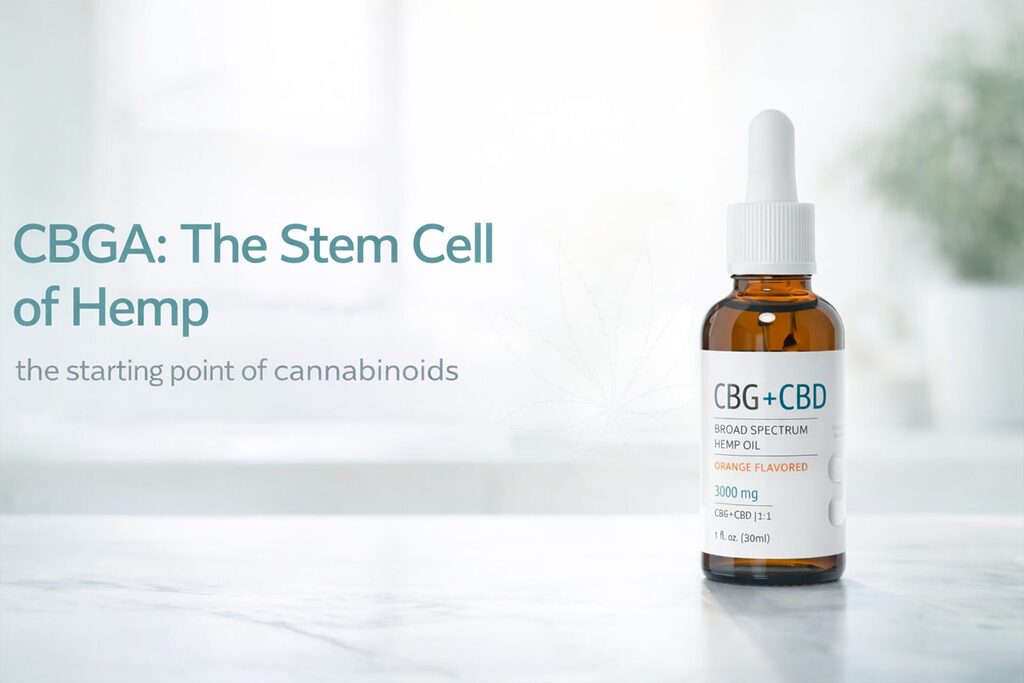
CBG oil and the Rare CBGA “Mother Cannabinoid”
Last updated: January 24, 2026
If you’ve been hearing more about CBG, you’re not imagining it. Interest is rising because this cannabinoid sits at a unique point in the hemp plant’s lifecycle, and because early research suggests it may influence pain pathways, inflammation signaling, and even brain-related processes.
Table of Contents
- Why CBGA is the “stem cell” of hemp
- Pain and inflammation: what the science suggests so far
- Brain, mood, and cognition: focus, fog, and neuroinflammation
- How to choose and use CBG oil safely
- FAQ
- Works Cited
Why CBGA is the “stem cell” of hemp
Think of CBGA as a starting material in the plant, often described as the biochemical precursor that can be converted into other major cannabinoid acids as the plant matures. That’s why you’ll often hear the phrase mother cannabinoid in CBG conversations: it’s shorthand for the idea that multiple cannabinoids begin their “life cycle” from this earlier compound.
Why CBG is rare to produce
In most hemp genetics, the plant doesn’t “hold onto” much CBG for long. As the plant develops, enzymes tend to convert precursor acids into other cannabinoid families. That means producers often need specialized cultivars and/or carefully timed harvesting and extraction to end up with higher CBG levels.
How it may work differently than CBD
In the body, cannabinoids interact with the endocannabinoid system, a network involved in balancing processes like discomfort signaling, immune activity, stress response, and more. CBG appears to act across multiple targets, cannabinoid receptors plus other receptor systems linked to mood, attention, and pain perception (including α2-adrenoceptors and serotonin-related receptors).
Takeaway: The buzz around CBG isn’t only hype, its “precursor” biology and multi-receptor activity are real. The big unknown is how well these mechanisms translate into consistent benefits in humans.
Pain and inflammation: what the science suggests so far
A lot of consumer interest centers on day-to-day discomfort and longer-term aches. When people say CBG feels “clean” or “steady,” they’re usually describing a non-intoxicating experience (unlike THC). Animal work also supports the idea that CBG doesn’t produce classic intoxication-type effects.
What we know about pain pathways
In preclinical models, CBG has shown anti-nociceptive (pain-response–reducing) effects, and it also interacts with receptor systems involved in pain signaling (including TRP channels). That’s part of why researchers are exploring it for chronic pain relief, but it’s important to say plainly: we still need more high-quality human trials to know where it truly fits.
What we know about inflammation
Inflammation is where CBG gets especially interesting. Research suggests it may reduce inflammatory mediators in certain models and may influence enzymes and markers involved in inflammatory signaling. A 2025 preclinical paper reported reductions in COX-2 and iNOS expression in an inflammation model, supporting the broader concept of anti-inflammatory support, again, primarily in non-human data.
Gut inflammation and IBD-type conditions
One of the most-cited CBG studies examined a mouse model of colitis and found improvements in multiple inflammatory markers and oxidative stress measures. This doesn’t prove treatment in people, but it’s a major reason CBG is discussed in the context of inflammatory bowel disease research pathways.
Takeaway: The strongest “signals” for CBG today are still preclinical, particularly for inflammation biology and pain pathways. That’s promising, but not the same as proven clinical effectiveness for chronic pain relief or GI disease management.
Brain, mood, and cognition: focus, fog, and neuroinflammation
People often describe CBG as more “alert” than CBD. Mechanistically, that’s plausible: CBG may act on adrenergic and serotonin-related receptors that influence attention, mood, and stress response.
Focus and mental clarity
Because CBG can interact with α2-adrenoceptors (linked to attention regulation) and serotonin receptors (linked to mood), researchers consider it a candidate for studies on calm concentration and stress-adjacent cognitive function. If you’re looking at it through a wellness lens, that’s where the “focused but not wired” anecdotes come from.
Brain fog and neuroinflammation
When people say “brain fog,” they usually mean slowed thinking, low mental energy, and trouble focusing, often tied to sleep debt, stress, chronic inflammation, or medications. CBG research is increasingly interested in neuroinflammation, oxidative stress, and neuronal resilience, but much of this remains early-stage.
Alzheimer’s and dementia: what “new research” really means
You may see claims that cannabinoids could “combat” Alzheimer’s or dementia. The more responsible interpretation is this: cannabinoids (including CBG and CBD) are being investigated for pathways related to inflammation, oxidative stress, and neuronal signaling, and some preclinical work suggests neuroprotective potential. None of that equals a proven prevention or treatment for Alzheimer’s disease in people.
Takeaway: CBG’s brain-related appeal is biologically plausible, and preclinical neuroprotection signals exist. But if you’re experiencing worsening memory issues, confusion, or personality changes, skip self-experimentation and get a medical evaluation.
How to choose and use CBG oil safely
This is where product quality and personal safety matter most, because supplements can vary widely in potency, purity, and labeling accuracy.
What to look for in a high-quality product
Before you try any hemp-derived supplement, look for:
- Third-party lab testing (COAs) that verify cannabinoid content and screen for contaminants (pesticides, heavy metals, residual solvents).
- Clear ingredient lists and carrier oil disclosure.
- Conservative, transparent labeling and no disease-treatment claims.
That “show your work” approach is especially important in the cannabinoid marketplace.
Why some people choose USA Medical CBG Oil
USA Medical CBG Oil emphasizes traceability, third-party testing, and a contaminant panel, quality markers that matter in an unstandardized supplement category. The orange flavor and MCT carrier oil may also help with palatability and ease of use for people who dislike the natural hemp taste.
Separately, some users report using USA Medical CBG Oil as part of routines for workouts, long workdays, or evening wind-downs, real-world feedback that can be helpful context, as long as it’s not confused with clinical proof.
Sensible safety practices (without giving personal medical advice)
Most tinctures suggest starting low and adjusting gradually, but your safest move is to:
- Follow the product label exactly.
- Avoid combining with alcohol or sedating meds unless a clinician says it’s safe.
- Check for interaction risk, especially if you take blood thinners, anti-seizure meds, or other drugs with narrow dosing windows.
If your main goal is chronic pain relief, it’s also wise to build a bigger plan around sleep, physical therapy/mobility work, and medical evaluation when needed, because persistent pain sometimes signals a treatable underlying problem.
Takeaway: If you’re going to try a cannabinoid supplement, prioritize testing transparency and conservative use.
FAQ
1) Is CBG intoxicating?
Current evidence suggests CBG is non-intoxicating and doesn’t produce THC-like “high” effects in animal testing, though human experiences can vary by product and dose.
2) Why is it called the mother cannabinoid?
The phrase mother cannabinoid refers to the plant chemistry idea that precursor compounds can be converted into other cannabinoid families as the plant matures.
3) Does it interact with the endocannabinoid system?
Yes, CBG has activity across cannabinoid receptors and other targets, so it can influence the endocannabinoid systemin a broader, multi-pathway way.
4) What does research say about chronic pain relief?
The best data so far is preclinical (animal/lab), suggesting CBG may affect pain signaling pathways. That’s encouraging, but it’s not yet the same as proven chronic pain relief in humans.
5) Can it help with inflammatory bowel disease?
CBG showed benefit in a mouse colitis model and is discussed in the research conversation around inflammatory bowel disease, but human trials are still limited.
6) Is it good for brain fog?
Some people report better focus, and the mechanisms are plausible, but brain fog can have many causes (sleep, thyroid issues, depression, long COVID, medications). If it’s persistent or worsening, get evaluated.
7) What’s the difference between CBD and cannabigerol?
Both are non-intoxicating, but cannabigerol appears to engage additional receptor systems (like adrenergic and serotonin receptors), which may contribute to different subjective effects.
8) What should I check before trying USA Medical CBG Oil?
Look for a current COA, confirm cannabinoid content and contaminant testing, and review your meds with a clinician if you’re unsure. USA Medical CBG Oil is positioned around those transparency features, which is what you want to prioritize in this category.
Works Cited
- Nachnani R, Raup-Konsavage WM, Vrana KE. (2021). Pharmacology-focused review of CBG.
- Li S. (2024). Review of CBG mechanisms and therapeutic potential (open-access full text).
- Zagzoog A. (2025). Mouse PK/PD study including non-intoxicating profile and receptor interactions.
- Borrelli F. (2013). DNBS colitis mouse model evaluating CBG effects on inflammatory markers.
- Kim JH. (2025). Preclinical anti-inflammatory findings including COX-2 and iNOS changes.
- FDA. (2024). Public health information on regulation of cannabis-derived products.
- Corroon J. (2020). Public health concerns and labeling accuracy issues in cannabinoid products.