Last updated: January 12, 2026
If you’re looking for a simple, real-life plan you can start today, this post is for you.
Think of it as holistic immune support without the overwhelm: a quick outdoor reset, a smarter next meal, and a few habits that help your body recover well overnight.
1) Make Room For Outdoor Time for Health (even if it’s cold or cloudy!)
You don’t need perfect weather to benefit from stepping outside.
Outdoor time for health can support your immune system indirectly by helping regulate your sleep-wake rhythm (your circadian rhythm), lowering stress, and adding light movement, all of which matter for immune resilience.
Daylight Matters Even When Vitamin D is Complicated
It’s true that vitamin D and sunlight are connected; your body can make vitamin D when skin is exposed to UVB rays.
But here’s the important nuance: vitamin D and sunlight aren’t a guaranteed “quick fix,” because time of day, season, latitude, cloud cover, skin tone, and sunscreen can all reduce vitamin D production.
So what should you do with that info? Treat sunlight as a helpful habit, not a promise.
A Simple “Go Outside” Plan You Can Do Today
To make this easy, here’s a quick approach you can repeat:
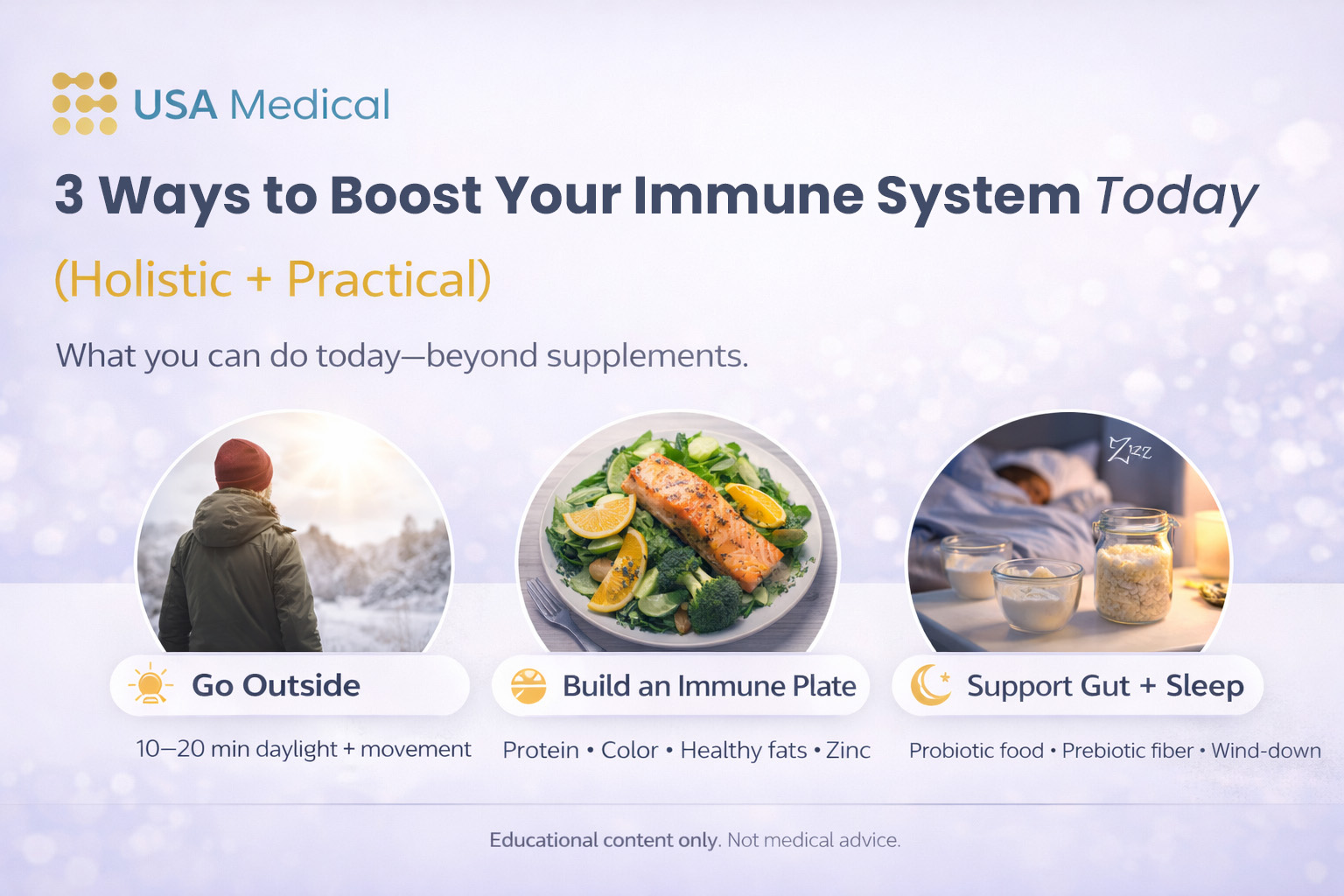
- Step outside for 10–20 minutes.
- If you can, add a gentle walk (even 5–10 minutes counts).
- Keep it comfortable: warm layers, a hat, and a pace that feels good.
That short dose of outdoor time for health can be one of the fastest no-cost habits to start today, because it stacks benefits (light + movement + mental reset) without requiring a full workout.
Section takeaway: If you only do one thing today, get outdoor time for health; it’s a small action that supports bigger systems (sleep, stress, and daily movement).
2) Build Your Next Meal Around Immune-Supporting Foods
Your immune system is busy every day, not just when you feel run down. One of the most holistic moves you can make is turning your next meal into a nutrient-dense, steady-energy plate.
Think Balanced Plate, Not Perfect Diet
A simple way to do this is to borrow the spirit of MyPlate; include a mix of produce, protein, and overall variety.
You don’t need to track anything; you just need to make the next choice slightly better.
Here’s a practical framework for immune-supporting foods that feels realistic:
- Protein helps provide building blocks your body uses for repair and normal immune function
- Colorful produce helps you cover key vitamins and plant compounds
- Healthy fats help with satisfaction and absorption of fat-soluble nutrients
- Fiber and fluids support digestion, regularity, and overall recovery
And because this is about action, not theory, pick one of these for today’s meals:
- Greek yogurt with berries and pumpkin seeds
- Eggs with sautéed spinach and whole-grain toast
- Chicken (or tofu) salad with olive oil and citrus
- Bean-and-veggie bowl with avocado
The point is consistency: immune-supporting foods are less about a single superfood and more about repeating a few smart defaults most days.
Section takeaway: The fastest nutrition upgrade is your next meal. Prioritize immune-supporting foods by anchoring your plate with protein, color, and fiber.
Step 3: Support Your Gut And Your Sleep (The Two Most Overlooked Basics)
A lot of immune wellness talk focuses on what to take. This section focuses on what to support: your gut barrier and your overnight recovery.
Gut Basics: Fiber First, Then Targeted Add-Ons
Your digestive tract is a major interface between your body and the outside world. For many people, improving gut health and probiotics starts with food habits, especially fiber, because fiber helps feed beneficial gut microbes.
If you want one easy gut win today, choose:
- One fiber-rich food (beans, oats, berries, chia, lentils), or
- One fermented food (yogurt, kefir, sauerkraut)
Supplement-style probiotics can be helpful for some people, but effects vary by strain and situation, and they’re not right for everyone.
Sleep Is Immune Support You Can’t Fake
Sleep isn’t optional wellness; it’s part of how your body regulates and repairs. The CDC notes that getting enough sleep is associated with getting sick less often.
If your nights have been messy lately, try this tonight:
- Dim screens 30–60 minutes before bed
- Keep bedtime and wake time within the same 60–90 minute window
- Do 2 minutes of slow breathing (inhale 4, exhale 6)
And don’t ignore the stress piece. Stress management for immunity doesn’t have to be complicated; it can be as simple as a brief walk, a few minutes of breathing, or a short reset routine you actually repeat. The CDC includes stress management as part of healthy habits that support immunity.
Section takeaway: If you want the biggest behind-the-scenes payoff, prioritize gut health and probiotics (food first) and protect sleep and immunity with a consistent wind-down.
How To Turn These Habits Into An Immune Health Routine (And Where Supplements Fit)
Here’s the truth most people need to hear: you don’t need more hacks, you need a repeatable system. This is where an immune health routine helps, because it turns good intentions into defaults.
The Simplest Weekly Plan (No Perfection Required)
Aim for this minimum:
- Outside most days
- One better plate per day
- A consistent bedtime window
Once your habits are stable, consider where an immune support supplement makes sense, especially if your diet is inconsistent, you travel often, or you want a convenient way to cover common immune-related nutrients.
A Supplement Option That Matches The Foundation Approach
If you’re looking for a formula built around nutrients, botanicals, and gut support, USA Medical Immune Support Capsules include Vitamin C, Vitamin E, Vitamin B6, Zinc, L-Glutamine, black elderberry, echinacea, garlic, turmeric (curcuminoids), and Lactobacillus acidophilus.
That combination is designed to complement lifestyle habits, not replace them, so it can fit naturally into an immune health routine alongside food, sleep, and stress basics.
FAQ
What’s The Best Way To Start An Immune Health Routine If I’m Busy
Pick one daily non-negotiable (walk outside, protein at breakfast, or a bedtime window). Once it’s automatic, add the next piece. A simple immune health routine beats a complicated plan you can’t repeat.
Does Outdoor Time For Health Still Help If I Don’t Feel Anything
Yes. Outdoor time for health often works quietly; supporting circadian rhythm, mood, and stress regulation, especially when it becomes consistent.
How Do Vitamin D And Sunlight Work Together
Your body can produce vitamin D when skin is exposed to UVB rays, which is why vitamin D and sunlight are linked. But many factors affect how much you make, so sunlight isn’t a guaranteed way to correct low vitamin D.
What Are Some Fast Immune-Supporting Foods I Can Eat Today
Think: yogurt with berries, eggs with greens, bean bowls, or soups with vegetables and protein. Immune-supporting foods are the ones you can repeat consistently; because repetition is what changes nutrient intake over time.
Are Gut Health And Probiotics The Same Thing
Not exactly. Gut health and probiotics overlap, but gut health also includes fiber intake, hydration, stress, sleep, and overall diet patterns. Probiotics are just one tool, and not always necessary.
How Are Sleep And Immunity Connected
Sleep helps regulate many body systems, and public health guidance links adequate sleep with getting sick less often, one reason sleep and immunity are so closely discussed together.
What’s One Stress Management For Immunity Tactic That’s Actually Realistic
Two minutes of slow breathing, a short walk, or a quick brain dump list before bed. Stress management for immunity doesn’t need to be big, it needs to be repeatable.
Works Cited
- NIH Office of Dietary Supplements (ODS). “Dietary Supplements for Immune Function and Infectious Diseases (Consumer).” https://ods.od.nih.gov/factsheets/ImmuneFunction-Consumer/
- NIH Office of Dietary Supplements (ODS). “Vitamin D — Consumer.” https://ods.od.nih.gov/factsheets/VitaminD-Consumer/
- CDC. “Healthy Habits: Enhancing Immunity.” https://www.cdc.gov/healthy-weight-growth/about/enhancing-immunity.html
- CDC. “About Sleep.” https://www.cdc.gov/sleep/about/index.html
- NHLBI (NIH). “Why Is Sleep Important?” https://www.nhlbi.nih.gov/health/sleep/why-sleep-important
- NIH Office of Dietary Supplements (ODS). “Probiotics — Health Professional.” https://ods.od.nih.gov/factsheets/Probiotics-HealthProfessional/
- NIH Office of Dietary Supplements (ODS). “Probiotics — Consumer.” https://ods.od.nih.gov/factsheets/Probiotics-Consumer/
- USDA MyPlate. “What Is MyPlate?” https://www.myplate.gov/eat-healthy/what-is-myplate
- NCCIH (NIH). “Turmeric: Usefulness And Safety.” https://www.nccih.nih.gov/health/turmeric
- NCCIH (NIH). “Garlic: Usefulness And Safety.” https://www.nccih.nih.gov/health/garlic