
What Is CBD and How Does CBD Oil Work?
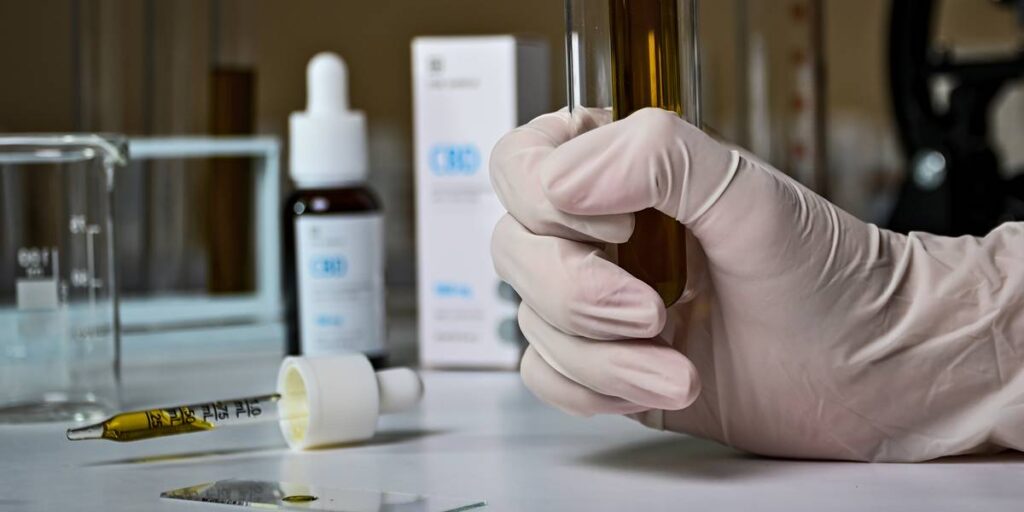
Cannabidiol, or CBD, is a compound found in the cannabis plant. This article shares general information about CBD products.
What is CBD?
Cannabidiol (CBD) is one of the phytocannabinoids found in the cannabis plant (Cannabis sativa). CBD is non-intoxicating and does not produce a high.
What is CBD oil?
CBD oil is a product made with an extract from the cannabis plant, often produced using supercritical extraction, a modern method that uses liquid carbon dioxide. The extract may then be refined further, including by industrial chromatography when needed.
Learn more about CBD and how CBD oil is made.
How does CBD oil work?
CBD may interact with the endocannabinoid system (ECS), a complex network involved in many normal functions in the body. The body has several cannabinoid receptors, each linked to different processes.
CB1 receptors are mainly found in nerve cells of the brain, spinal cord, and peripheral nervous system. They are also present in other organs and tissues, including immune cells, the spleen, adrenal glands, and pituitary gland, as well as cells in the heart, lungs, reproductive system, urinary system, and digestive tract.
CB2 receptors are found mainly in immune cells, the spleen, and tonsils.
What Is the Endocannabinoid System?
What is CBD oil good for?
Many people want to understand what cannabis oil is.
The potential uses of CBD are being intensively and continuously researched. Based on current trends, we can expect many new applications of CBD oil and CBD products to be discovered in the coming years.
Scientific articles and studies published in their original language about CBD oil can be found on PubMed. PubMed is a free search engine that provides access to references and abstracts primarily covering life sciences and biomedical topics from the MEDLINE database.
What Research Says About CBD Oil
Cannabidiol, or CBD, is a compound found in the cannabis plant. This article shares general information about CBD products.
CBD oil is also used in some cosmetic products. For sport-related use, check the current guidance from your league or organization.
How to Use CBD Oil: Simple Usage Tips
Research on hemp extracts has looked at a wide range of CBD amounts, including 5 to 200 mg daily, depending on the person and other factors. Higher amounts have also been studied.
In most cases, it is advisable to start with a smaller amount (daily 3-5 mg of CBD) and gradually increase the doses every 4-5 days. CBD can be used at any time of day, according to personal needs.
✅ Accurate CBD dosage calculation
- USA Medical CBD oils come in 30 mL bottles, and the label shows the amount of CBD per 1 mL in milligrams.
- 1 ml of CBD oil contains about 30-35 drops, making it easy to calculate approximately how many mg of CBD are in one drop of the product. For example, one drop of a 500 mg product contains roughly 0.5 mg of CBD.
- In some higher-strength CBD oils, one drop contains about 3 mg of CBD.
- The included pipette has a marked 1/4 mL scale to make dosing easier.
If you’re new to CBD, some people start with 3-5 mg daily and increase gradually every 4-5 days if that feels appropriate. Consider checking with a healthcare professional.
Frequently Asked Questions
If you have any unanswered questions about CBD oil, click here!
Which CBD Strength Should I Choose?
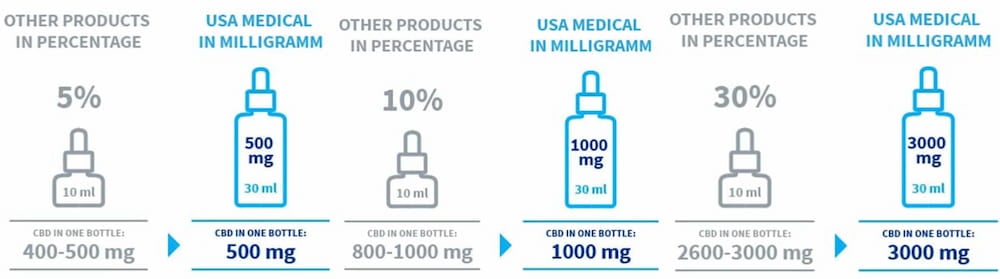
The percentage shown on a CBD label can be misleading. What really matters is the amount of CBD in the product, expressed in milligrams.
Sometimes it can be very difficult for the customer to decide exactly which CBD concentration to choose. In some products, it’s not always clear how much CBD is present in the total amount of the product or per single drop.
The graphics below compare CBD content by percentage with the total amount of CBD in milligrams in USA Medical CBD products. The 30 mL bottle size makes it easier to compare product size and total CBD content than a 10 mL bottle.
CBD oil experiences
People around the world have shared a range of experiences with CBD oil.
According to a 2019 Gallup study in the U.S.:
- Many Americans use CBD products.
- Many Americans are aware of CBD products.
CBD oil is still a newer category for many shoppers, but many people already choose USA Medical CBD oil products.
Read customer reviews for our CBD products.
What’s the Difference Between CBD Oil and Hemp Oil?
Hemp seed oil and CBD oil are different products with different compositions and uses. CBD may interact with the endocannabinoid system (ECS), while hemp seed oil does not play the same role.
Hemp Oil or Hemp Seed Oil?
Hemp oil usually refers to hemp seed oil, which is made by pressing the seeds of the hemp plant (Cannabis sativa). It naturally contains omega-6 and omega-3 fatty acids, along with gamma-linolenic acid and other naturally occurring compounds.
Because hemp seed oil is made from seeds, it contains no cannabinoids, so it has no CBD or THC.
CBD oil is not the same as THC oil.
CBD oil, unlike hemp seed oil, contains an extract from the cannabis plant that is blended with a carrier oil such as grapeseed oil, hemp seed oil, MCT oil, or olive oil. The extract is often produced using supercritical carbon dioxide extraction, a gentle method that helps preserve cannabinoids and terpenes. Any remaining THC is then removed through industrial chromatography. The result is a CBD oil intended to be THC-free.
What is the endocannabinoid system?
The endocannabinoid system (ECS) is an important network involved in many processes regulated by the central nervous system (CNS). It is present throughout the body and helps support normal balance, or homeostasis.
Most people have heard of this system in connection with the term “homeostasis” or through the growing interest in CBD oil. The ECS is involved in a range of normal body processes.
Learn More About the Endocannabinoid System
How do I choose the right CBD oil?
Most CBD sellers claim that their product is the best. However, before forming your own opinion, it’s worth considering certain criteria that will help you decide which CBD oil is best for you.
When choosing a CBD oil, consider these factors:
- Quality , Review the formula and how it’s made.
- Traceability , You can identify the product’s origin and manufacturer.
- Experience , How long the brand has been in business.
- Price-to-volume ratio , CBD amount in mg compared with product size.
- THC content , Check the label on full-spectrum and broad-spectrum products.
- Lab Testing and Test Reports
- GMP , Made according to Good Manufacturing Practice (GMP) principles.
- Customer reviews are available for the brand’s products.
How to Choose the Right CBD Oil
What to Look for When Buying CBD
Some CBD brands clearly list the amount of active ingredient in milligrams, for example 1000 mg. Others list only a percentage and leave out the bottle size, such as a small 10 mL bottle marked only by percentage. That can make products harder to compare, so shoppers should check both the CBD amount and the total volume before buying.
Of course, the price of CBD oil is important too. The most expensive CBD oil is not always the best. The price-to-quality ratio or the price-to-CBD content (in mg) ratio should be among the factors you consider when buying.
Since calculating the CBD content given in percentages isn’t always straightforward, we recommend choosing products where the CBD content is expressed in milligrams.
How to calculate and compare CBD content.
CBD Oil Pricing
How much does CBD oil cost? What factors affect the price of CBD oil, and how can you compare different CBD products? CBD oil is still a relatively new product for many U.S. shoppers, so it may take some time to find the right product at the best price.
CBD oil price can depend on these factors:
- How much CBD the product contains.
- Quantity and size.
- And, of course, the quality.
Learn More About CBD Oil Pricing
Cannabidiol, or CBD, is a compound found in the cannabis plant. This article shares general information about CBD products.