
Men’s Multivitamin vs Women’s Multivitamin: Benefits That Matter (and Why Formulas Differ)
Last updated: February 5, 2026
Table of Contents
- What’s actually different between these two formulas
- How a men’s formula can support men’s needs
- How a women’s formula can support women’s needs
- Smart, safe ways to use a multivitamin
- FAQ
- Works Cited
What’s actually different between these two formulas
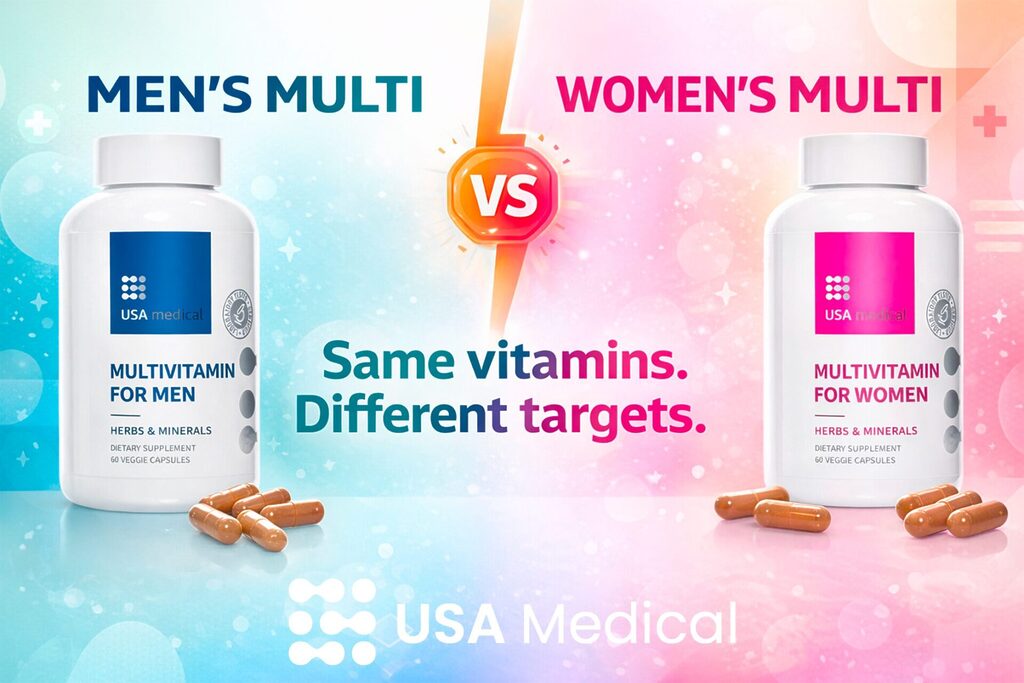
At a glance, both products are very similar: they share the same core vitamins and minerals (A, C, D, E, multiple B vitamins, zinc, selenium, copper, manganese, chromium, molybdenum, calcium, and magnesium). The meaningful differences are mainly in vitamin E, and niacin (B3).
Key differences you provided:
- Vitamin E: higher in the men’s formula (25 mg) vs the women’s formula (13.5 mg). Vitamin E acts as an antioxidant in the body.
- Niacin (B3): higher in the men’s formula (30 mg) vs the women’s formula (15 mg NE). Niacin helps convert food into energy (cellular energy metabolism).
What this means practically: a daily multivitamin often covers broad “nutrient insurance,” while the men’s and women’s versions tweak a few nutrients that are commonly emphasized for different life stages and health priorities.
Takeaway: The formulas overlap a lot, so the real value is understanding how specific differences (like extra E or more B3) may match your needs and tolerances.
How a men’s multivitamin can support men’s needs
A men’s multivitamin is often designed around common gaps and goals: energy metabolism, immune function, reproductive health, and long-term heart and muscle support. Your men’s formula leans in with higher vitamin E and niacin, while keeping key essentials like zinc, vitamin D, and B vitamins strong.
Energy and performance: B vitamins + niacin
Your formula provides high amounts of several B-complex vitamins, including B1, B2, B3 (niacin), B6, B12, biotin, and pantothenic acid. These nutrients help the body run energy-related reactions that turn food into usable energy and support normal cell function. Niacin, specifically, is directly tied to cellular energy pathways.
Because the men’s version contains 30 mg niacin, it’s closer to the adult UL of 35 mg/day for niacin from supplements/fortified foods, some people are more prone to flushing or stomach upset at higher intakes. (This is one reason the “more is better” mindset can backfire.)
Immune strength: vitamin C, vitamin D, and zinc
This is a classic trio for immune function, and your men’s formula includes all three at meaningful levels. NIH notes that immune function relies on certain vitamins and minerals, including vitamin C, vitamin D, and zinc.
- Vitamin C also acts as an antioxidant in the body, helping protect cells from free-radical damage.
- Vitamin D supports bone health and also has important roles in muscle and nerve function.
- Zinc is needed for many enzymatic processes and supports immune function, protein/DNA synthesis, and wound healing.
When people talk about zinc benefits for men, it often comes up in the context of reproductive biology, since zinc is involved in reproduction and is found in high concentrations in certain tissues.
Antioxidant and cellular protection: vitamin E + selenium
Your men’s version has a higher dose of vitamin E (25 mg). Vitamin E acts as an antioxidant, helping protect cells from oxidative damage.
Selenium also supports protection from oxidative damage and plays roles in thyroid hormone metabolism and reproduction via selenoproteins.
Together, these nutrients contribute to antioxidant support, especially for people whose diets are low in nuts, seeds, seafood, and produce.
Metabolic and muscle function: magnesium + chromium
Magnesium is a cofactor in hundreds of enzyme systems and is involved in muscle and nerve function, blood glucose control, and blood pressure regulation.
Chromium is often marketed for blood sugar control, but NIH notes the evidence is mixed and major organizations do not recommend chromium supplements as a diabetes treatment. Still, chromium remains a common inclusion in multis aimed at metabolic health.
Takeaway: A men’s multivitamin can be a practical “baseline” tool for energy systems and immune coverage, especially if your diet is inconsistent, while the higher niacin and vitamin E may be the most distinct label-level differences to weigh.
How a women’s multivitamin can support women’s needs
A women’s multivitamin is commonly framed around energy, immunity, bone support, and reproductive planning, especially folate. Your women’s formula is very close to the men’s, but it highlights folate in DFE and keeps niacin lower.
Reproductive planning: folate and folic acid
One of the most evidence-based sex-specific nutrients is folic acid. The CDC recommends that women capable of becoming pregnant get 400 mcg of folic acid daily to help prevent neural tube defects (serious birth defects of the brain and spine).
This is one of the clearest “women-specific” reasons a daily multivitamin may be suggested for women who could become pregnant, even before pregnancy is planned.
Energy and blood health support: B vitamins (especially B12)
Your formula includes strong levels of B-complex vitamins, including B12. Vitamin B12 is required for healthy red blood cell formation, DNA synthesis, and normal nervous system function.
For women with low intake of animal foods (or those with absorption issues), B12 is a particularly important nutrient to monitor.
Bone, muscle, and immune support: vitamin D + magnesium
The women’s formula includes vitamin D, which helps the body absorb calcium and supports bone health, with additional roles in muscles and nerves.
It also includes magnesium, which supports muscle and nerve function and is involved in many biochemical reactions.
Even though the calcium amount here is modest (50 mg), vitamin D still matters because it supports calcium absorption and overall skeletal health.
Skin, connective tissue, and immune defense: vitamin C + vitamin A
Vitamin C supports antioxidant functions and is involved in collagen formation (a key structural protein in skin and connective tissue).
Vitamin A (as beta-carotene) supports normal vision and immune function.
Balanced antioxidants: vitamin E (lower dose) + selenium
Your women’s product contains vitamin E at a lower amount than the men’s version. Vitamin E still contributes to antioxidant support by helping protect cells from oxidative damage.
Selenium also supports antioxidant defenses and thyroid function.
Takeaway: A women’s multivitamin can be especially helpful as a consistent source of folate/folic acid for reproductive planning and as general nutrition backup for energy, immunity, and bone-related nutrients like vitamin D.
Smart, safe ways to use a multivitamin
A daily multivitamin is best viewed as a supplement to a diet, not a replacement for fruits, vegetables, protein, fiber, and healthy fats. Here are practical safety tips that apply to both formulas:
Before choosing a product, it helps to know what a multi can and can’t do:
- It can support nutrient adequacy (help fill gaps).
- It can’t “out-supplement” poor sleep, a very low-protein diet, or unmanaged medical conditions.
When taking a multi, keep these guardrails in mind:
- Avoid stacking duplicates. If you also take separate vitamin D, zinc, or B vitamins, your totals can climb quickly. Excess intake can be a problem for some nutrients.
- Watch niacin sensitivity. The men’s formula’s higher niacin may be more likely to cause flushing in some people; individual tolerance varies.
- Pregnancy changes the equation. If you are pregnant or trying to conceive, use a clinician-recommended prenatal rather than assuming a standard multi is enough. CDC specifically emphasizes folic acid intake for prevention of neural tube defects.
Takeaway: The best multivitamin is the one that matches your life stage, doesn’t push you near upper limits unnecessarily, and complements (not replaces) healthy routines.
FAQ
1) Do I really need a daily multivitamin?
A daily multivitamin can help if your diet is inconsistent, you avoid certain food groups, or you have increased needs. It’s less useful as a “shortcut” if the basics (sleep, diet quality, activity) are missing.
2) What’s the biggest functional difference between these two formulas?
In your comparison, the biggest differences are higher vitamin E and niacin in the men’s version, and DFE labeling emphasis for folate in the women’s version.
3) Are zinc benefits only relevant for men?
No, zinc benefits matter for everyone because zinc supports immune function, wound healing, and many enzymes. It also has recognized roles in reproduction in both sexes.
4) Why does the women’s label mention DFE for folate?
DFE accounts for different absorption between natural food folate and supplemental folic acid. That’s why a label can show both folic acid (mcg) and DFE (mcg DFE).
5) Is vitamin D mainly about bones?
Bones are a major reason, vitamin D helps the body absorb calcium, but it also supports muscle and nerve function.
6) What role does vitamin C play in a multivitamin?
Vitamin C acts as an antioxidant and supports collagen formation and immune-related functions.
7) Should I choose the men’s product if I want more antioxidant support?
Higher vitamin E can contribute to antioxidant support, but antioxidant needs are best met through diet pattern first (colorful produce, nuts, seeds), with supplements as backup.
8) Does chromium in a multivitamin improve metabolic health?
Chromium is often marketed for blood sugar, but evidence is mixed; it’s not recommended as a stand-alone approach to diabetes management. Still, it’s commonly included in formulas aimed at metabolic health.
Works Cited
- NIH Office of Dietary Supplements (ODS). Zinc , Health Professional Fact Sheet.
- NIH ODS. Vitamin D , Health Professional Fact Sheet.
- NIH ODS. Vitamin C , Health Professional Fact Sheet.
- NIH ODS. Vitamin E , Consumer Fact Sheet.
- NIH ODS. Folate , Consumer Fact Sheet.
- CDC. About Folic Acid.
- NIH ODS. Magnesium , Health Professional Fact Sheet.
- NIH ODS. Chromium , Consumer Fact Sheet.